
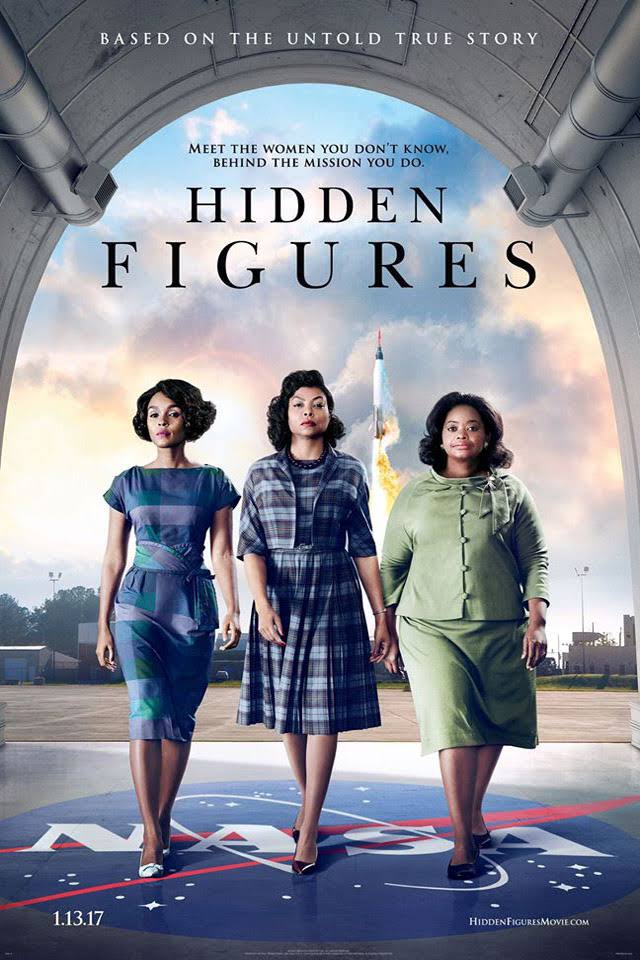
 An absolutely out-of-this-world biographical film! 20th Century Fox, PepsiCo, and TSG Entertainment present Theodore Melfi’s incredible film depicting the lives and careers of three African-American women whose work was extremely influential in the early days of NASA’s Mercury, Atlas, and Apollo missions. In all likelihood, there may not have been successful launches, orbits, and landings if it weren’t for these brave women who refused to back down and take the back seat to white men and women at a time that even government buildings still segregated restrooms, water fountains, and “community” coffee pots. Every once in a while, there is a biographical drama that packs a powerful socio-political message within a simple but brilliant story that is told incredibly successfully. Hidden Figures is a film that should have been released many years ago. How stories like this one go untold, is bewildering. Between the powerful performances, excellent writing, meticulous direction, and fantastic score, this is definitely a film to catch in theaters this weekend. Although Hidden Figures has been on a limited release since December, it receives its nationwide release this weekend and one to watch for when Oscar nominations are released.
Hidden Figures is the story of three absolutely brilliant African-American women who served as the problem-solving geniuses behind some of NASA’s greatest space operations in all of history including John Glenn’s (Glen Powell) first earth orbit and Alan Shepherd’s symbolic penetration of earth’s atmosphere into space. Katherine Goble (Taraji P. Henson), Dorothy Vaughn (Octavia Spencer), and Mary Jackson (Janelle Monae) work as computers (the term used at the time before the conventional modern use) at NASA’s Langley facility near Washington D.C. Never assigned to a permanent position, these talented ladies work tirelessly to support NASA’s operations and aspirations of space exploration. At a time in which it was incredibly difficult for persons of color–much less women–to climb out of temporary and entry-level jobs, these women do not permit archaic societal norms to stop them from reaching their greatest potential as an engineer, programmer, and mathematician respectively. This untold story will move you as these three women, that society and NASA determined could not be more than computers, are significantly instrumental in launching the space program that indirectly united people from all over the world and cemented the U.S. as a then-leader in space exploration.
What a story! And the best part about it is that it is based on actual events and three real women who are responsible for the success of NASA’s early space programs and even help to launch some of the more contemporary missions. Unlike many biographical dramas, there is a comprehensive nature to this film as it contains two important stories. There is the foreground story featuring the women at the center of the movie, but there is also the story of the state of the U.S.’ domestic socio-political policies at a time of civil rights unrest–especially in places like Virginia. Both stories parallel one another and serve to pack a powerful punch. After watching this film, it is clear that this film wishes it had existed in the 1960s. Within the former story, the focus is primarily on the life and career of Katherine Goble followed by Dorothy Vaughn, and to a lesser extent, Mary Jackson. Each woman specializes in a different STEM (as it is now commonly referred) area. Katherine is a mathematical genius matched by none, Dorothy understands early computer language better than anyone at NASA, and Mary is an aspiring engineer with a brilliant mind for aerospace design. The latter story, underscoring the socio-political civil rights unrest, is certainly highlighted in the film but never takes the focus completely off the story in the foreground; however, is vitally important to this powerful story with a message that those who you least expect to rise to be leaders in their respective fields, can and will! Despite all the challenges coming from within the work place and the country itself, these three women prove that you should never be afraid to be the best. Being good, isn’t good enough. Be the best!
Although this is truly a powerful film with a beautiful message that is just as relevant today as it would have been 50 years ago, it never quite hits the mark that I had hoped it would and perhaps that is due to the PG rating. Suffice it to say, there are some remarkable scenes with powerful speeches, but the film is just shy of the level of intensely as it should have contained. I realize that some of what transpired in the Space Task room, wind tunnels, and courtroom may have been taken from transcripts for authenticity, as this is a movie, I feel that there should have been more of a dramatic license taken out to increase the emotional impact of the film. It certainly has a moderately high emotional impact, but there was definitely the potential to take it up several more degrees. Two scenes come to mind. (1) Katherine challenging the segregation policies at NASA as it relates to common comforts such as restrooms and coffee and (2) Mary petitioning the court to permit her enrollment for graduate level engineering classes held at an all-white school. Dorothy also has a couple of encounters with her superior (Kirsten Dunst) but they are more subtle–no less powerful and important to the film. In regards to the scene in which Katherine confronts Mr. Harrison, the scene feels a little cut short of where it should have ended and Mr. Harrison’s (Kevin Costner) response could have been more dramatic. When inside the courtroom as Mary was addressing the judge, this would have been the perfect time for a speech that would have brought a flood of tears to the eyes, but it stops short of where it could have gone too. Over all, the screenplay is excellently written. These are just two areas that I feel could have struck a more powerful emotional cord. As it is, these scenes are still some of the most brilliant in the film and leave an impact.
One of Mr. Harrison’s lines in the film contains a large degree of irony. The line was something to the effect of “How can the U.S. government justify NASA when it is consistently unable to get into and explore space?” The irony therein is seen in today’s defunding of NASA for, essentially, that very concept. NASA did not lose the bulk of its government funding due to any particular presidential administration but from remaining in the 80s and never launching into the 21st century. After the Space Shuttle program, NASA did very little to grow–its technology and engineering remained fairly stagnant. Sure, communication technologies greatly benefited from NASA engineers, but that is not what made NASA an exciting organization from the 60s thru the 90s. What made NASA great was the perception of being explorers–exploration excited a society! Once NASA no longer appeared to be focused on exploration and shifted its focus to communication technologies, it lost that public support that was such a part of what brought so many people together. In many ways, the perceptions and issues facing NASA prior to and during the early missions is plaguing it today. Instead of an inability to launch a man into space and orbit the earth (later to land on the moon), there is now the demonstrable evidence and perception that NASA has an inability to create manned vessels capable of exploring space. Satellites and camera are great, but nothing parallels the actual exploration of space by humans. If NASA could one again be seen as explorers, then perhaps a new generation would petition the government to once again proactively support the iconic organization.
Hidden Figures is definitely not to be missed while it is in theaters. It is a larger than life story that is best appreciated on the big screen. For those in the audience who remember the early days of NASA, there is plenty of vintage footage to accompany the modern cinematic storytelling in this film. Even Kennedy’s famous “we will go to the moon” speech is in this movie. More than a biography of the glory days of NASA, this is a story of three women who, against all odds, rose to the challenges they faced on a daily basis to prove that women are capable of anything that a man can do. Between breaking the sound barrier, gravitational pull, and paving the way for equal rights and treatment in the workplace, this film will hit close to home for many who know what it is like to feel oppressed for who they are.
Written by R.L. Terry
Edited by J.M. Wead
 R.L. Terry ReelView