
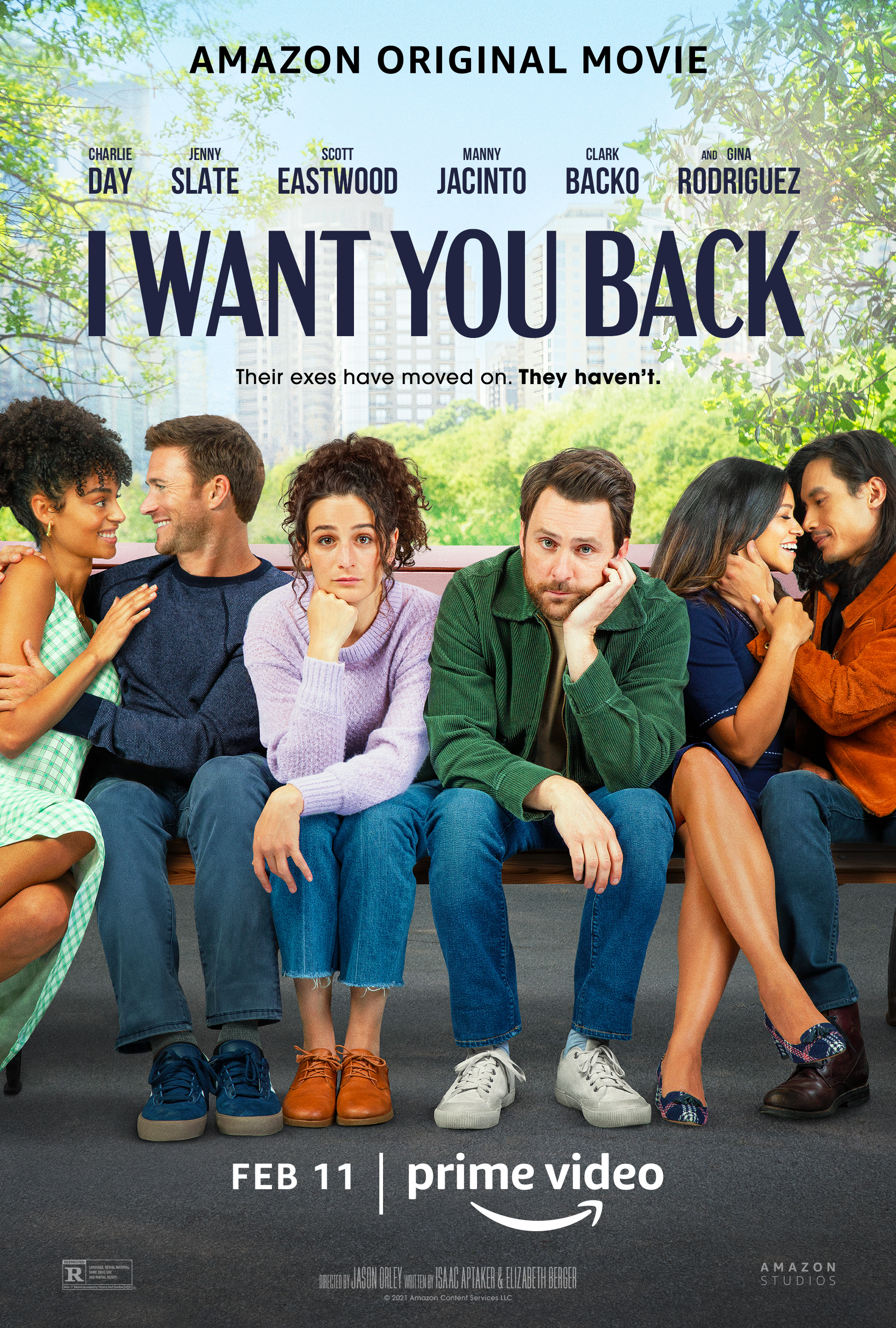
I Want You Back romcom review

Heartwarming! From the outstanding cast chemistry to the clever writing, you need to make I Want You Back part of your Valentine’s Day celebrations at the cinema (for the limited theatrical run) or on Amazon Prime Video. Much like Broken Hearts Gallery showed us that the romcom can be reimagined for today’s teen and 20-something audiences, Jason Orley’s I Want You Back is the romcom reimagined for 30-something audiences. If it can make cynics like me once again believe that my “plane mask buddy” (you’ll just have to see the film to get the reference) is still out there, you too will find the story incredibly endearing! While the classical American romcom has largely fallen out of favor with a significant portion of movie audiences over the last decade or so, there are films that take the foundation of what made the romcom such an American cinema staple, and upon it, build plots and characters that both resonate across ages and cultures and still deliver the quirks and laughs that are such a hallmark of the romcom. It’s been a long time since I’ve witnessed such excellent chemistry between an ensemble in a comedy, and it is the characters that will command a rewatch of this soon-to-be quintessential romcom, that will undoubtedly rank up there with the likes of Sleepless in Seattle, You’ve Got Mail, Two Weeks Notice and more.

Peter (Charlie Day) and Emma (Jenny Slate) are total strangers. When they meet, they realize they were both dumped on the same weekend. Their commiseration turns into a mission when they see that each of their ex-partners have happily moved on to new romances.

What makes this movie work so well is the focus on character-driven (or dramatic) storytelling. When the character(s) drives the plot, we refer to it as drama, while the action driving the plot is referred to as melodrama. Just a little film studies there, for ya. The movie wastes no time in establishing who our central and chief supporting characters are; this is an important screenwriting decision because it allows for the character reactions to drive the story in a manner in which we believe everything the characters do because the rules for the characters were established up front. You can get away with anything if you set it up appropriately.

Yes, there are melodramatic moments (and you will need to engage your suspension of disbelief), but every emotional beat and turning point is earned and delivered meaningfully. Meaningful. That is a description that is so often overlooked in comedies. When writers focus so much on laughs, the art of meaningful storytelling is lost. In the writers room, a strong story with well-developed plot and characters can always be punched up with laughs, versus a laugh-a-minute story with poorly-developed plot and characters, which has a problem requiring major diegetic surgery.

Authenticity! You will find the characters to be incredibly believable and real, with little to no pretense. Our leads and supporting cast feel like your coworkers, neighbors, and friends. We all have someone in our lives of whom the characters will remind us. In fact, you will likely see yourself IN one or more of the characters. When you can place yourself in the story, the degree to which it impacts you will significantly increase. And it’s even better when you can laugh along with the characters. But what makes these characters connect and resonate with audiences is the unexpected level of vulnerability the characters demonstrate. And it’s our vulnerabilities, our flaws and the ability to learn, grow, and experience redemption that makes us human.

Perhaps you are like me, a romantic cynic. So, your default setting is disdain and pessimism for anything that even has a hint of romance and erotic love. I find it difficult to connect with the typical romcom, even the great ones of the 80s, 90s, and early 2000s. Just feels like something so out of reach and unbelievable that I’d rather watch another horror movie. If someone like me can be touched by I Want You Back, then I know that it can touch even the most cynical. Personally, I see myself as two-parts Emma and one-part Peter. And it’s the prolific opportunities to connect with the characters that will cause this movie to find a place in your heart.

Ryan teaches Film Studies and Digital Citizenship at the University of Tampa. If you like this article, check out the others and FOLLOW this blog! Interested in Ryan making a guest appearance on your podcast or contributing to your website? Send him a DM on Twitter or email him at RLTerry1@gmail.com! If you’re ever in Tampa or Orlando, feel free to catch a movie with him.

Follow him on Twitter: RLTerry1

“Snowden” movie review

snowdenA political docudrama that only Stone could pull off so effectively! Once again, acclaimed director Oliver Stone brings another socio-political issue and figure to the screen. Whether you’re of the school of thought that Edward Snowden should be charged with espionage or heralded as a hero, this film will definitely challenge your point of view. But, isn’t that what Stone is known for??? More than a docudrama of the life of Snowden, Stone’s film is a dramatization of the state of government surveillance. One could argue that surveillance is the star of the film, not Snowden. The intent of the film is not to cast blame on either Snowden or the U.S. Government, but to cast doubt. The simple placement of doubt can be far more powerful than blatantly passing judgment or blame. If there was any ‘doubt’ that Stone is one of the most important filmmakers covering modern historic events, then this film will cast aside any remaining doubt. Few directors, have been so successful in taking cold, hard facts and transforming them into a story fit for cinema. The success of this film is attributed to the incredible lead talent. Joseph Gordon-Levitt and Shailene Woodley have excellent chemistry on screen. Accompanied by a strong cast of supporting players such as Zachary Quinto, Nicholas Cage, Scott Eastwood, Tom Wilkinson, and Melissa Leo, this film’s cast will have your attention until the final fade to black.

Oliver Stone’s Snowden takes you on a journey through the significant events of Snowden’s life from 2006 to 2013 when he was finally granted temporary asylum in Russia. The reason why his name is so famous or infamous–that depends on which school of thought you are from–is not new and even blasé at this point; but, the events of his professional and personal life that culminated in the leak and disclosure of NSA (National Security Administration) surveillance secrets and programs are not as widely known. Disillusioned with his career as a highly sought after top digital media and intelligence contractor, Edward Snowden (Gordon-Levitt) begins to wrestle with being able to justify and reconcile the rampant surveillance data that the NSA is collecting and how it affects both private citizens as well as those who are being hunted for crimes against humanity and the U.S. After deciding that it was best to go public with the information, he is then on the run of his life. A traitor to some and a hero to others, this film will prompt you to perhaps rethink the actions of Snowden.

Although this film has slow pacing, for those who are interested in the life of the–to borrow from J. Jonah Jameson–hero or menace, Stone’s docudrama will successfully hook you and draw you into this world of intelligenceSnowden is a particularly interesting docudrama because this film essentially contains three smaller movies–a three legged stool if you will. There is the most dominant story of Snowden discovering the copious amount of secret government surveillance data being collected by his software. Next, we have the personal romantic story of the ups and downs of his relationship with the liberal, artistic, amateur photographer Lindsay Mills (Shailene Woodley) and how his professional life gently affected their relationship. And finally, the story that made Snowden a household name: his leaking and dissemination of top secret NSA surveillance methods and everything else Snowden knew about questionable NSA methods of collection. For most people, that third story is all anyone knows. But, in order to truly get an idea of the pressure Snowden must have been feeling, it is imprint to take the other two stories into account. That is precisely what Stone did with this film. Stone’s version of the life and times of Snowden takes the other Snowden film Citizen Four a step further to truly be able to analyze all the known elements.

There are many excellent qualities in the writing and visual storytelling in this film, but there are two areas that appear to falter or suffer in the translation of these now historic events. The focus of the movie is definitely on what led Snowden to leak the NSA secrets, but there is a significant amount of time spent on the relationship between Snowden and Mills. One could argue that the strain of his relationship with Mills contributed to his eventual disclosure of the NSA secrets. Cinematically speaking, the strategic placement of the personal life of Snowden is important because the audience needs a break from the flat panel displays, computer code, and “geek-speak.” Unfortunately, Stone and his co-writer Kieran Fitzgerald did not carefully contract and craft the personal dialog as well as they did the info tech and military dialog. In many ways, the forced personal story of the relationship between Snowden and Mills comes off as a forced element from producers to make the film more relatable to those who are not AS interested in the military side of the story and more interested in the outside/personal influences that affected Snowden’s actions. It’s not unlike fans wanting to know the personal details of a celebrity’s life. Unfortunately, this human interest subplot does not play out as well as the two dominant stories at the forefront of this film. That being said, both Gordon-Levitt and Woodley are extremely committed to the characters/historic figures they are portraying. I cannot think of two other actors who could have been better suited to play these roles. Gordon-Levitt nailed Snowden’s voice, body language, and nuances.

The other area of this film that appears to suffer is the structure–the map, if you will. Any first year film student can tell you that flashback movies can be dangerous. Often times, the flashback is used as a copout plot device that simply plays off as lazy writing. From a technical perspective, a movie that uses the flashback as a means to tell the story is referred to as a nonlinear film. Now, I am not stating that Stone’s movie is lazily written and structured; however, I do not feel that the constant back and forth between the past and then-present were handled delicately or strategically enough. Most of the time, one of the comments I have about movies that rely upon the flashback as a plot device to tell the story is ‘Why is there a need for a flashback? Just let the main story BE the main story.’ The flashback concept works for some films like The NotebookFried Green Tomatoes, or IT; but it does not work for others such as Ladder 49 or The Weight of Water. Most of the time, a flashback is used out of convenience to fill runtime; meanwhile, the audience usually doesn’t care about the past as much as what is going to happen next in the present. Stone and Fitzgerald are mostly successful as keeping the audience entertained, caring about, and longing for what happens next in BOTH the past and present; however, I found the movie to go between both the present and past too much, almost to the point that it was a little confusing. Opening with Snowden and the small group of journalists was a great way to begin, but I feel that the story of Snowden would have been a little more gripping if we were able to watch the events from 2006 to 2013 unfold without present-day interruptions. Still, the ending that was selected for the film was both effective and strategic.

Oliver Stone’s Snowden is not a film for everyone. For those who enjoy socio-political movies or docudramas of historic figures, then you will likely enjoy it! If you are looking for an action-packed spy thriller, then is this not for you. Unlike some movies that truly ARE better experienced on the big screen, this is one that is equally experienced as well on the big or small screen.