
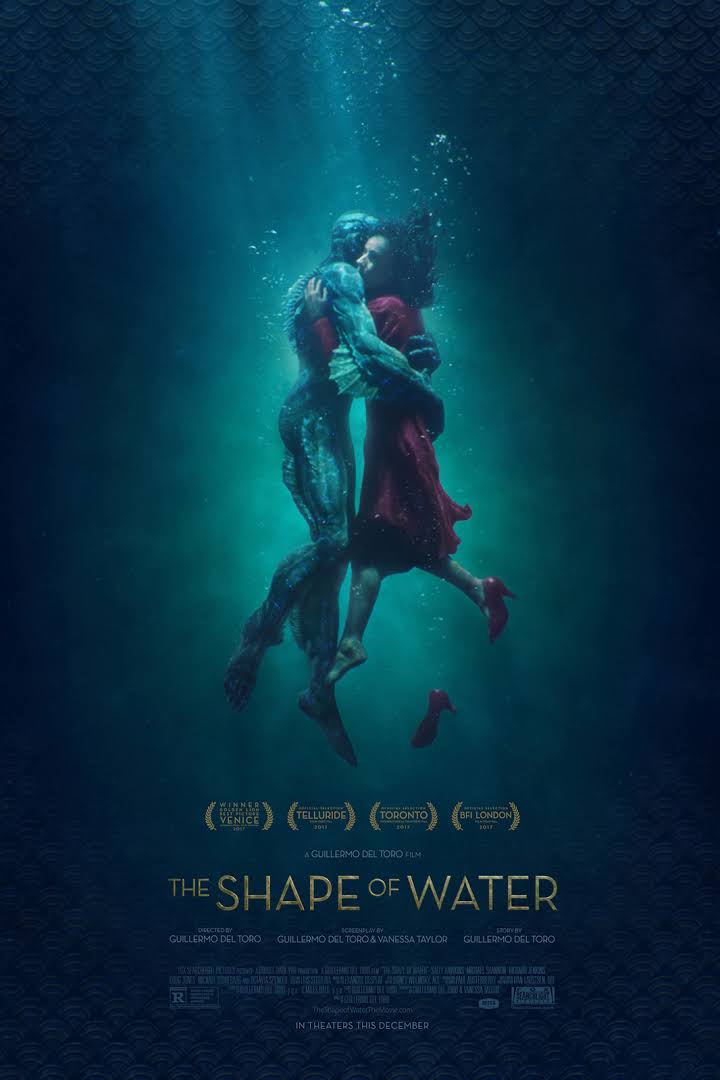
 Absolutely enchanting! Guillermo Del Toro’s The Shape of Water is a beautiful modern fairy tale told through a classical means. From the provocative first scene to the endearing final moments, this film explores the human condition in an innovative way that highlights the spirits of kindness, generosity, and love. In a film that could have so easily played out like many other-worldly science-fiction love stories, this story demonstrates the power of cinematic storytelling full of brilliantly developed characters and excellent direction from Del Toro. Positively gripping. The Shape of Water provides audiences with a fresh perspective on the “monster movie” genre by taking you on a whimsical journey into the belly of a government research facility during the Cold War where you meet characters you love and love to hate along the way. As with many of his other films, Del Toro once again crafts an imaginative experience through the creation of memorable characters grounded by solid writing, direction, and cinematography. It seems like “genre films” are becoming a thing of the past, because so many want to exist in multiple planes; however, for all the elements at its heart, The Shape of Water is a classic monster genre film but breaks new ground.
Elisa (Sally Hawkins) is a mostly isolated mute young lady who works in housekeeping at a remote, underground government research facility near Baltimore. With only her starving artist neighbor Giles (Richard Jenkins) to keep her company at home and her close friend Zelda (Octavia Spencer) to watch over and speak for her at work, she leads a rather mundane life but longs for music, adventure, and romance. Taking place during the Cold War in 1962, Elisa’s encountered the strange and questionable over her time in and out of cleaning labs. Her nondescript life will be forever changed when she discovers the lab’s newest secret–a mysterious amphibian-like creature who lives in an aquarium tank. Over the days, Elisa feels compelled to visit the creature as the two of them develop a trusting bond. When the creature’s very life is at stake, Elisa must work quickly to construct a plan for his safe evacuation.
The Shape of Water has one of the most innovative openings to a film in that it juxtaposes a serene, calming yet mesmerizing sequence of underwater shots during the opening title sequence against a rather provocative first scene. Del Toro will successfully have your attention for the entirety of the film. It isn’t often that we get fairy-tale like narration at the beginning of a monster movie, and Del Toro’s choice for the beginning narration was absolutely perfect. It not only provided strategic exposition, but set the tone of the film. What we are about to watch may contain elements of monsters and mysteries, but it is a modern romantic fairy tale. Horror and science-fiction have often been used as conduits for filmmakers to explore the human condition and all its imperfections and growth; so by combining elements from both to create an innovative monster movie, Del Toro provides audiences with a fantastic opportunity to use the film’s diegesis as a mirror to our modern lives. Although the “beauty and the beast” style love story is central to the film, the film also comments on topics such as race, marriage, and class during the 1960s. There is also a side story that alludes to how members of the LGBTQ community were treated in the workplace and within the community. An incredibly comprehensive plot that never loses focus on the main story.
What an excellent cast! Sally Hawkins brings such endearing and powerful subtlety to her mute character. Her commitment to Elisa is so exquisite that you will swear that you can hear her voice through her sign language. Much in the same way we explored interspecies communication in last year’s Arrival, we witness just how the movement of hands and facial expressions know no bounds when establishing relationships with those with whom we cannot verbally communicate. In many ways, this movie is a combination of Beauty and the Beast, TV’s Swamp Thing, Arrival, and a little Creature from the Black Lagoon. Hawkins’ exceptional performance may very well land her an Oscar nomination, and quite possibly a win. Doug Jones’ creature is a brilliant combination of monster and lover. From the moment you encounter him, you will feel a human-like connection to his character. Like with Hawkins’ Elisa, Jones’ creature exhibits the power of subtlety. That seems to be a common element of this film: subtlety. So often the techniques of the pioneers of cinema are forgotten. Hitchcock proved over and over again that the camera itself can create suspense. Of course, he took many of his techniques from silent cinema where the camera was instrumental in visually communicating so much. Del Toro utilizes this power of the camera to not only visually create emotions but to work through actors to allow subtle powers of character to enhance the experience of this movie.
Beyond our central characters, Zelda (Octavia Spencer) and Giles (Richard Jenkins) have mini-movies of their own. And indirectly, their mini-movies have an impact on the larger story; however, these side stories never eclipse the central plot and only serve to bolster the overall experience. Spencer’s character enables audiences to explore marriage in the 1960s and Jenkins’s character provides a platform for discussion regarding how ostracized members of the LGBTQ community were before more modern times. There is also a scene where a classy looking black couple was denied seating at a diner. So many societal themes that can be used as a framework through which to understand the time in which this story takes place, and now the characters can be used to explore modern themes as well. Each and every chiefly supporting player has a significant impact upon the central diegesis of The Shape of Water. Del Toro took special care in integrating every element and making sure each aspect of the story was never just filler or for shock value. Each character, each scene, each camera angle moves the story forward.
The reality of love and relationships juxtaposed against an imaginative backdrop grounded in a literal view of life in the 1960s comprise this world created by Guillermo Del Toro. Whether you enjoy an excellent monster movie or old-fashioned romance, you will enjoy The Shape of Water. The brilliance of this film can be found in how this modern fairy tale is told through classical means. I also enjoyed the references to classic Hollywood movie musicals and dramas that can each be seen in the plot of this film. No image is ever wasted in Del Toro’s film. If there is one negative critique, the second act is a little drawn out and could have been trimmed a little, and some added suspense would have been appreciated in the second act as well.

 R.L. Terry ReelView