
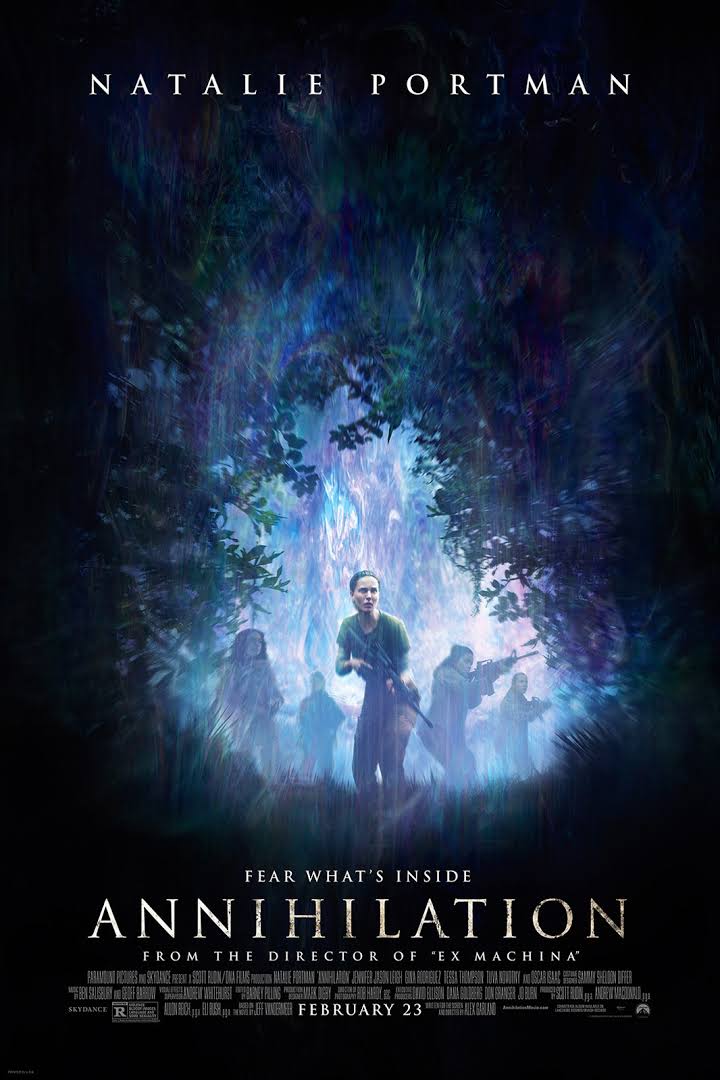
“Annihilation” film review

Outstanding craftsmanship that provides a trippy, surrealist experience! It’s been a long time since I’ve seen a horror science-fiction film like this one–one that harkens back to the manner in which Stanley Kubrick terrified audiences with his cinematic masterpieces. The brilliance of this film is the visually disturbing storytelling that’s built upon metaphysical and philosophical queries as well as Freud’s uncanny. Written and directed by Alex Garland (Ex Machina) and based upon the Southern Reach book series by Jeff VanderMeer, Annihilation boasts an all-female lead cast that takes the audience on a gripping, nail-biting adventure into the unknown that is frocked with wonder and tragedy. Falling in line with extraterrestrial films, this one exists somewhere between Alien and Arrival with influences from Kubrick and even Salvador Dali. Don’t wait for it to be released on Netflix internationally to avoid watching it at your local cinema; this IS a film best viewed, experienced, and enjoyed on the BIG screen–and not the 65in in your living room. For those who look for and appreciate science-fiction and/or horror films that explore psycho-social and institutional themes, then this is truly a film for you. Cognitively engaging and physiologically disturbing, Annihilation is a turbulent, horrific adventure.

After a mysterious meteor-like object strikes a lighthouse in Area X (most likely the swamplands of northwestern Florida), an increasingly growing membrane-like phenomenon is slowly swallowing up the land around it. When several paramilitary and scientific expeditions do not return from exploring the anomaly, biology professor Lena Kane (Natalie Portman) is aggressively recruited to work on the next team of scientists to track, report, analyze and potentially rescue former teams from what’s being called “the shimmer.” Professor Kane and her team have no idea that they will be facing their worst nightmares inside the shimmer as they explore this unknown world filled with dangerous opposition from the creatures that live within and the psychosis-like tension between the team members themselves.

Definitely not a film for the general masses. And you know what??? That is perfectly fine. In fact, that’s why this film works so incredibly well as an avant-garde-like science-fiction horror film. Had it directed for the masses, the film would not be nearly as stimulating psychologically and physiologically. Much like Garland did with the Oscar-winning Ex Machina, he crafts a world based on the best-selling series that takes the audience on a disturbing journey into the macabre, which juxtaposes the physical and metaphysical dimensions. Garland’s Annihilation is a masterful cinematic work that combines excellent writing with exceptional imagery and stunning practical effects. If Dali were alive today, this is the kind of film that he would have wanted to work on because there is such a heavy surrealist approach to the production design and visual effects. But this film is so much more than just the cinematic beauty of the motion picture. There are philosophical questions that one may ask oneself that create an added dimension of engagement that further immerses the audience into the world of the film.

Much like with Ex Machina, Garland shows an obsession with the need to see and see through when observing an unknown entity that may or may not be sentient. Paralleling how he set up the glass wall between Caleb and Ava (the AI) in the compound/lab designed by Nathan (Oscar Isaac, who is also in Annihilation), Garland sets up the interrogation room in which we are first introduced to Lena while she is being interviewed by the team in hazmat suits. I love the play on perspectives, vantage points if you will in both movies. That fluctuation between a filtered and unfiltered view of the phenomenon under observation offers much depth to the storytelling. In Annihilation, we are initially introduced to the shimmer, and world within, through sensors, readouts, and other “filters” but then we are thrust into the horrifying flora, fauna, and animal life without any type of protective boundary. Freud refers to the revealing of that which should remain hidden or the return of the repressed (which we literally get to witness in this film) as that which is uncanny (click for article). Just as our characters are constantly searching for clarity, you will find yourself paying close attention to the unknown to gain an unhindered understanding of what you are witnessing.

Not your average science-fiction horror film, this one will truly get under your skin–much like The Shimmer invades the bodies of those who choose to enter the dark twisted, refracted world of that which lies beyond our senses. Truly terrifying, this film is one for those who love a sci-fi horror that will prompt you to contemplate the themes and subtext of the movie. One of the quandaries that face the characters, and by extension, the audience is the idea of self-destruction versus suicide–the physiological versus the psychological components. For those who may worry that the film is “too intellectual,” the story is told in such a way that it not only appeals to film critics, academics, or horror aficionados but can be enjoyed by those who like a good, disturbing scare. The fact that there is the “intellectual” dimension to the film adds to the experience for those who appreciate that element in visual storytelling.
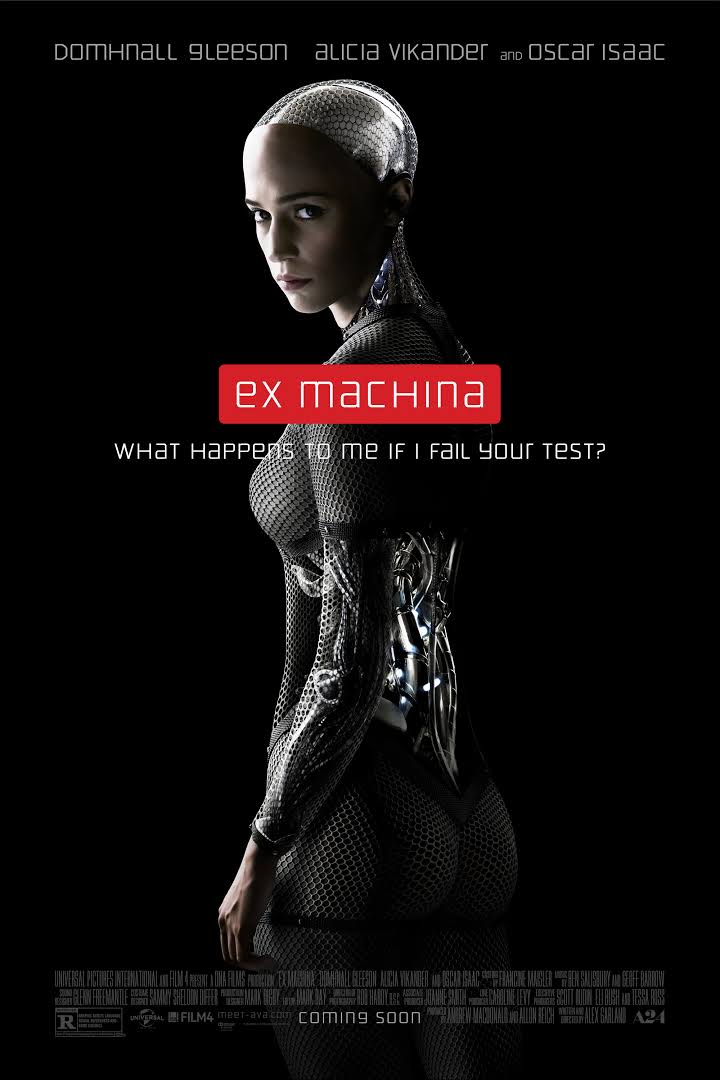
“Ex Machina” Movie Review

Ex_MachinaA thought provoking science-fiction film. Universal Pictures and Film 4’s Ex Machina is a brilliant work of fantasy/science-fiction. From the time the movie begins to the time the credits roll, your mind will have a heightened sense of anticipation of what is about to happen next. This is one of those movies that will eventually find its way into film appreciation classes in order to dissect the many themes, both direct and indirect, implied and inferred, woven meticulously throughout the narrative. Over the years, there have been numerous other artificial intelligence (AI) movies, but this one is likely the best example and best produced movie in this sub-genre of science-fiction and fantasy. Maybe it’s because the dawn of AI is most likely upon us? Or, just because for once, a more serious and more realistic approach to tackling this fascinating subject is being showcased in theatres. From the writing, to the directing, to the cinematography, to the acting, Ex Machina is definitely a film to catch if you are a fan of science-fiction films that have real sociological themes and comment on the age-old quandary: man vs machine.

Ex Machina is about a young programmer/coder named Caleb (Domhall Gleeson) who works for the very “Google-like” company called BlueBook. Upon winning a contest to meet with the reclusive founder of BlueBook, Caleb is whisked away by helicopter to the beautiful mountain residence of founder Nathan (Oscar Isaac). Shortly after his arrival, Caleb learns that Isaac used the contest as a rouse in order to select a candidate for the Turing Test (an AI evaluation test, so to speak, to determine if an AI actually has human-like intelligence and reasoning). Caleb is astounded to come face-to-face with the world’s first true AI (Ava, played by Alicia Vikander) in the form of a beautiful woman who is precisely his type. After a few days of testing, it becomes clear to Caleb that there is something more than meets the eye; something darker underscores the bizarre testing in the remote mountain retreat.

Director Alex Garland, best known for 28 Days Later and Sunshine, demonstrates his writing-directing prowess in this beautiful, cutting edge movie. Although it is ordinarily fairly easy to become bored watching three principle and one supporting characters for nearly two hours, Garland uses his gift to orchestrate this film in such a way that each scene is fresh and clearly advances the plot. This film is one of the best examples of a well-developed plot that is constantly reinforced, checked, and advanced throughout the narrative. His handiwork is also seen in the character development, expressions on, and blocking of the actors. Like building a model, Garland provides solid plot structure upon which the more superficial elements are laid. Beyond the high concept plot, there are brilliant themes and provocative subtext that will aid in the overall performance of the film, and give film scholars, writers, and the scientific community something to toss around in spirited debates. Aside from the running theme of man vs machine, there are also themes of whether or not a machine is “born” hetero or homosexual, much in the same way that very debate is discussed in regards to humans. A quick note regarding the exquisite production design, it is simple yet absolutely perfect for the movie. I really enjoyed the straight lines and sharp angles, very Frank Lloyd Wright.

If you know anything about literature or screenwriting, you are most likely familiar with the term or plot device known as deus ex machina (latin for “god from the machine”). The textbook definition is something to the effect of a plot device whereby seemingly unsolvable dilemmas are suddenly and abruptly resolved by the unexpected intervention of a new character, event, or object; this often occurs when the writer has painted him/herself into a corner. Knowing this, analyzing the title is quite interesting. Essentially the title means “from the machine.” After watching the movie, I am unsure as to what is coming ‘from the machine,’ unless you count the emergence of human-like intelligence. Otherwise, it really isn’t explained–the significance of the title–beyond the fact the movie centers in and around the testing of an AI machine. It’s entirely possible that the title was selected simply because it sounds cool, fits easily on a marquee, and does point to the plot. Exploring the significance of titles and title sequences can often unlock hidden meanings in the film. On a side note, next time you watch Ridley Scott’s Alien, really pay attention to the opening title/credit sequence.

At the center of the movie is the Turing Test. Nathan tasks Caleb with the responsibility of objectively and subjectively analyzing and evaluating Ava to see whether or not she possesses human reasoning, problem solving, dialoging, and cognitive processing. His goal is to determine if Ava is essentially human. The following analysis does contain some information that may spoil the movie for some–fair warning–if you need to, please skip to the last paragraph. Following a sequence of events, Caleb devises a plan to escape with Ava after she professes feelings for him and he falls in love with her. Although at first in disbelief regarding her humanness, he believes she has the capacity to love and process cognitively equal to and perhaps superior to flesh-and-bone humans. Like any good antagonist, Nathan discovers the plan by way of a hidden camera; and instead of eliminating Caleb, explains that Ava is actually screwing with his mind–pretending to love him. He doesn’t believe Nathan, and continues with his plan that was already hatched, unbeknownst to Nathan. After a struggle, Ava is set free and winds up killing Nathan. Despite the professed feelings for Caleb, Ava leaves him locked away in a room with no means of escape. She boards the helicopter and heads off to the world of humans with no one to blow her cover or enslave her.

This is where the plot does leave room for question. Although the ambiguity of the reasoning behind Ava’s decisions involving murder and entrapment may have been intentional, the driving force behind the decisions to murder Nathan and leave Caleb trapped in the house, left to die should have been made clearer. But on the other hand, the ambiguity is perfect material for debating what may have been going through her “mind.” The reasoning for her murder of Nathan is fairly clear. He caused both mental and physical abuse, oppressed her, leaving her locked in a glass room like a lab rat. He stood in her way between slavery and freedom, and she needed him eliminated. Here’s where it gets tricky: why leave Caleb to die in the house when she professed her love? I think it’s because she was way more human than either Nathan or Caleb could have dreamt. She pretended to love Caleb. If pretending to have feelings for someone in order to use them to your benefit isn’t as human as it gets, I don’t know what is. Even though we never get a definitive answer in the diegesis of the movie, the audience is previed to that information.

Another interesting possible theme to discuss is Ava’s first encounter with another AI. There is a shot sequence between Ava and another female Asian AI immediately following her emergence from her glass cage. In the manner in which this encounter is shot, it could be read as lesbian undertones. No explicit romance is witnessed, but there are subtleties that Ava may be sexually attracted to the beautiful Asian female AI. Is it possible that something switched on inside her when she encountered another female for the first time? Perhaps innate repressed feelings were ignited, despite what Isaac said he programmed her to be? Maybe feelings that weren’t there for Caleb were made more intense by the other “female” in the house? This gets back to the argument if a human or machine is programmed from day one to be hetero or homosexual. These are questions best left up to those who want to speculate the inner-workings of Ava’s psychology and chemistry. But, nevertheless, are fun to talk about. Most likely, she was just plotting with the other AI, against Nathan and Caleb; but I feel there is a slight possibility of the former.

Ex Machina represents some of the best that the science-fiction/fantasy movies have to offer. It contains social commentary, science, and excellent subtext. While many science-fiction films suffer from adequate and well-crafted plot development, this one is a shining example of how beautifully produced a science-fiction/fantasy film can be. What makes this movie an excellent one to watch is the ability to intrigue the audience with both a scientific element and one that taps at your psyche and prompts you to think about the positive and negative consequences of developing a human-like AI. If you haven’t seen the movie yet, definitely plan to catch it in theatres.

Ryan is a screenwriting professor at the University of Tampa and works in creative services in live themed entertainment. If you like this article, check out the others and FOLLOW this blog!

Follow him!

Twitter: RLTerry1

Instagram: RL_Terry

Thrillz (theme parks): Thrillz.co