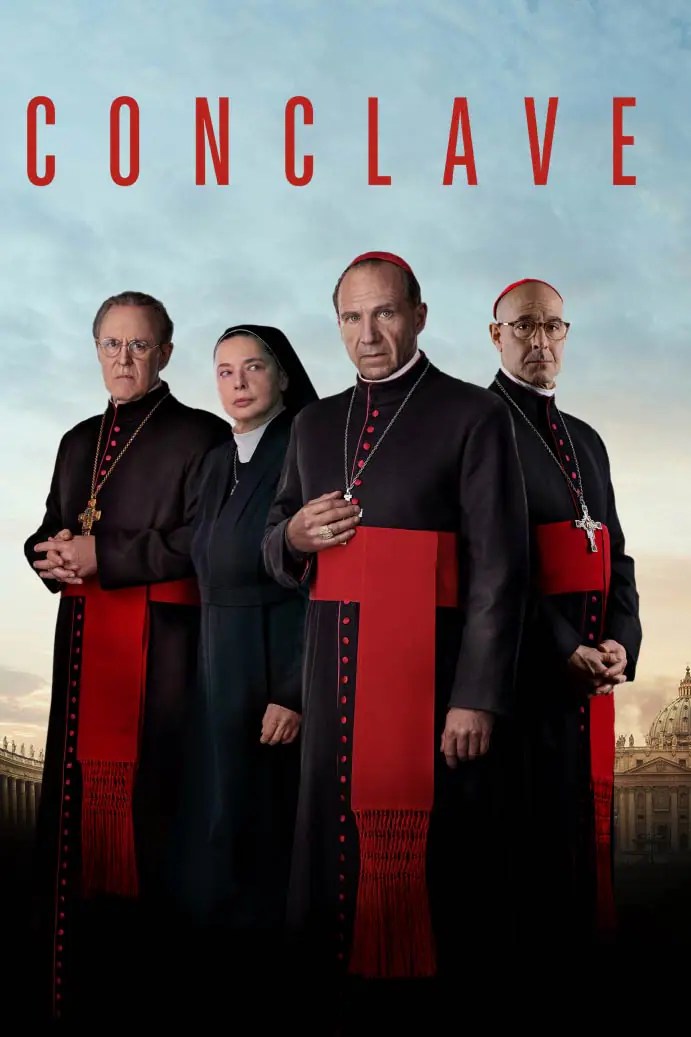
CONCLAVE film review

Spellbinding and poignantly reflective! It’s like House of Cards but with Cardinals and Nuns. Truly captivating.

Cardinal Lawrence has one of the world’s most secretive and ancient events, participating in the selection of a new pope. Surrounded by powerful religious leaders in the halls of the Vatican, he soon uncovers a trail of deep secrets that could shake the very foundation of the Roman Catholic Church.

I feel the film strikes a delicate balance between reverence for the subject matter, yet provides us with a subtle critique of its institutional traditions. The story unfolds with deep respect for the gravity of the papal election. However, through its unfolding intrigue, the film also reminds us that faith should ultimately be centered on God rather than on rigid customs or political maneuvering. The narrative underscores how human ambition, secrecy, and tradition can sometimes cloud the true purpose of faith. And the plotting is meticulously structured. Every revelation is carefully placed, each character’s motivations are unraveled with precision, and the pacing ensures that the suspense never overshadows the film’s thoughtful meditation on spirituality and power. I also like how the screenplay both honors faith-based institutional traditions but challenges the audience to reflect on what truly matters in faith.

To me, the cast collectively delivers a compelling performative dimension that drives the captivating nature of this film. Feinnes, Rosselini, Tucci, Lithgow—what a powerhouse. The actors did a brilliant job of drawing audiences into the pomp, circumstance, and almost clandestine nature of the election of the Pope. Feinnes’ performance as Cardinal Lawrence was bold and convicting, yet incredibly nuanced at the same time. The other cast member I want to spotlight is Isabella Rossellini as Sister Agnes. And while the gravitas she brought to every scene, in which she was featured, allowed her to steel the spotlight, there were Amy moments—to my delight—that I could hear Lisle Von Rhouman from Death Becomes Her. 

I love how the characters are not merely realistic individuals vying for power within the Vatican but, a closer reading reveals something far more important in these characters: the key characters each represent broader themes of faith, morality, and human ambition. Each character serves as a symbolic force in the intricate balance between divine guidance and earthly maneuvering. Just to name a few: I see Feinnes’ Lawrence as the moral compass, Tucci’c Bellini as the political strategist, Lithgow’s Tremblay as the power seeker, and Rossellini’s Sister Agnes as the voice of reason or conscience. Each character represents different facets of power, faith, and human imperfection within religious institutions. Collectively, the characters offer audiences more than a quasi-political thriller, but a meditation on the true meaning of leadership.

The exquisite costuming and production design truly immerse us into the grandeur and secrecy of the Vatican. The costuming itself was a work of art that demonstrated careful attention to ecclesiastical tradition but also incorporated visual storytelling elements. The choice of fabrics, embroidery, and even the way the robes drape contribute to the film’s overall sense of realism and reverence, and serve as an extension of the setting and the personalities of the characters. As for the production design, every detail, from the richly embroidered vestments to the imposing architecture, reinforces the film’s solemn, high-stakes atmosphere. A key aspect of this visual achievement is the film’s use of Cinecittà Studios in Rome. Founded in 1937, it is one of the largest film studios in the world and has a rich, legendary even place in cinema history. Which I could go into for the rest of out time together. But suffice it to say, it was home to Liz Taylor’s Cleopatra and Isabelle Rossellini’s famous director father filmed at the storied studio. You can visit it, and its theme park today! 

I feel the film has a lot to say about a variety of topics. If I was to identify a few, I’d say there are themes and messages concerning faith and politics, which we witness in the actions of the cardinals, while ostensibly seeking to follow God’s will, we are reminded that they are humans influenced by personal beliefs, rivalries, and ambitions. While it’s a group of men in this film, in this situation, we can really extend this idea to any and everyone. I also like how the film explores the immense weight leadership brings with it. Probably what hit me the most was how the film was not so presumptuous as to posit answers or solutions, but rather more concerned about prompting introspection. It respects the sacred traditions of the Church while also questioning the imperfections of any human-led institution—which is all of them. The film suggests that true faith is not found in ceremony or power but in the individual’s relationships with God and his or her fellow man.

I love when a film transcends its premise. While the surface of a film can be intriguing, entertaining, funny, or scary, it’s what lies beneath the surface that offers a timeless cinematic richness. And Conclave is one of those films. It offers us a profound reflection on the world we live in, and the intricate dynamics that shape our daily lives. This film serves as a mirror to the struggles of leadership, morality, and power that permeate every institution—from politics to corporations, from religious organizations to personal relationships.
Ryan is the general manager for 90.7 WKGC Public Media in Panama City and host of the public radio show ReelTalk about all things cinema. Additionally, he is the author of the upcoming film studies book titled Monsters, Madness, and Mayhem: Why People Love Horror. After teaching film studies for over eight years at the University of Tampa, he transitioned from the classroom to public media. He is a member of the Critics Association of Central Florida and Indie Film Critics of America. If you like this article, check out the others and FOLLOW this blog! Follow him on Twitter: RLTerry1 and LetterBoxd: RLTerry

“The Nun” Horror Movie Review

Well, it’s not the worst horror movie ever. Universes are popping up everywhere, and why should The Conjuring not follow in suit? Based on the real-life paranormal work of Ed and Lorraine Warren, there is certainly enough material from which to build a universe; but if this is a universe and the movies are planets, then perhaps The Nun will go by way of Pluto. Sometimes it’s included, sometimes it’s not. One may even go so far as to say that The Nun is truly unholy–an unholy hot mess of a movie. That’s not to say that it isn’t fun to watch. Like with horror movies, in general, it is a fun watch with a large group of people all reacting at the same time. While recent horror films focus on creating an atmosphere of dread and developing characters that the audience cares about, and then crafting twisted moments of terror such as A Quiet Place or Hereditary, this movie follows bad horror movie tropes that may aid in getting you to jump here and there, but ultimately fail at delivering anything truly scary or horrific. With German expressionism being at the very roots of the American horror film, as seen in NosferatuPhantom of the Opera, and DraculaThe Nun seems like such a missed opportunity to produce a terrifying gothic horror movie.

When a nun at a cloistered abby in the hills of Romania is discovered as having committed suicide by hanging, the Vatican calls upon the service of Father Burke (Birchir) to investigate the occurrence to determine if there is any unholy work at play. Under the advisement of the Vatican, Father Burke is asked to work with Irene, a young nun from a Catholic school because she has the gift of visions that may aid in their mission. Although Irene has yet to take her final vows, she agrees to accompany Father Burke to Romania to uncover why one of her sisters would commit suicide. Father Burke and Sister Irene soon discover that a most unholy spirit lives within the castle, and that the abby’s convent of nuns were protecting the world against a malevolent demon who must be sent back to the depths of hell.

Like many of you, I too was initially optimistic for this origin story as the glimpses of The Nun in the Conjuring movies are terrifying. Partly, these glimpses are creepy because we see very little of the nun. The demon nun suffers from some of the same problems that are witnessed in the Insidious movies. When the demon was shadowed, barely visible–but just enough to frighten you–he was scary; but then he turns into Darth Maul and loses that level of fright he had through most of the first movie. Simply stated, we saw too much of him. To the point that he almost became a parody of his former self. Likewise, the nun’s exaggerated features, yellow eyes, and jagged teeth quickly transition from scary to almost funny. Funny in that it felt campy or over the top. Director Corin Hardy obviously does not know the power of subtlety. Diegetically, the plot of The Nun plays out as incredibly predictable. The nun or another ghoulish apparition appears right when and where you expect it to happen. No surprises here. In an era that arthouse horror is attracting mainstream audiences–and making bank at the box office–it’s quite upsetting that a movie that had the setting and characters for arthouse horror decided to go the “paint by the numbers” route instead of joining other trailblazers.

A grossly underused setting. The movie begins in candle-lit hallways in a medieval castle in the foggy hills of Romania. Visually, the movie appeared to be setting up a story and setting that would have that beautifully dark gothic feel and look; however, it quickly turns into another generic haunted house movie. We begin with an incredibly effective foreboding atmosphere complete with everything you want to see in a gothic horror film, then scrap it for unimaginative rooms and cheap exploitation. Gothic horror films possessed an ability to depict terrifying stories with minimal dialogue. Dialogue was an extension of the plot; it did not force the plot. The Nun had all the right elements for a frightening horror film but failed to deliver the Conjuring universe movie we wanted or expected. It’s like, you can buy all the ingredients to make an exquisitely delicious dish you had at a French restaurant; but if you do not know or choose to ignore the proper amounts and order of the ingredients, then your dish will most likely fail to meet your expectations. Moreover, there were many moments that felt gimmicky, felt forced.

With such an amazing setting, the german expressionistic and gothic roots should have ben channeled more effectively. Whether you are familiar with the term or not, you are likely familiar with what it looks like–especially if you are a horror junkie like myself. The antithesis of French impressionism (art displaying authentic life), German expressionism sought to reflect real life but through metaphor, allegory, and symbolism. An indirect representation of observations of real-life. Expressionism allows the filmmaker to visually explore themes such as death, life, sex, institutions, religion, and more. The beauty is its ability to provide social commentary without being overt. Examples of German expressionism can be found in older films such as Nosferatu and The Cabinet, Dr. Caligari, mid-century films like Psycho and The Exorcist, but also found in newer films such as Batman Returns and Crimson Peak. Mostly associated with film noir, german expressionism is foundational to the looks and feel of horror films as well. Visually, German expressionism is characterized by exaggerated architecture, shadows, twisted landscapes, and sharp edges. The very look of it is creepy. German expressionism takes many visual queues from gothic architecture. It’s that gothic looks and feel that was mostly ignored in the setting and actions of The Nun even though it was a perfect candidate for it.

This movie will undoubtedly do well at the box office over the next couple of weekends as even “ehh” horror is bankable. Before I allow myself to get too discouraged, I look to how the sequel to Annabelle was fantastic after the first installment was a let down. If Annabelle Creation can improve upon its predecessor, then the forthcoming Nun sequel can do the same thing under the right direction with the right screenplay.