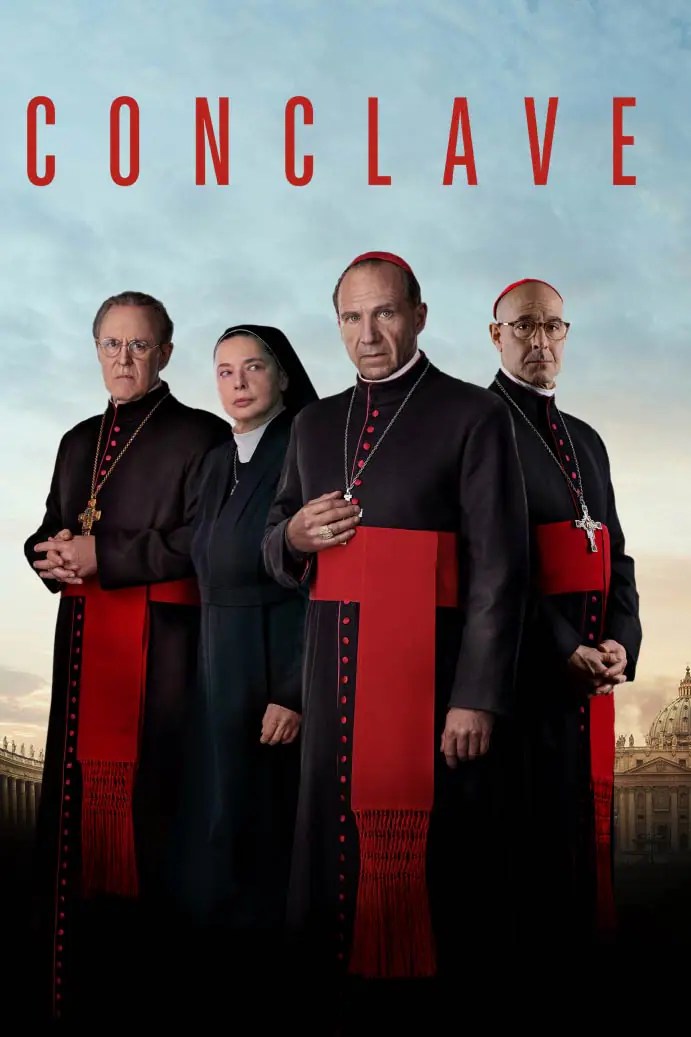
CONCLAVE film review

Spellbinding and poignantly reflective! It’s like House of Cards but with Cardinals and Nuns. Truly captivating.

Cardinal Lawrence has one of the world’s most secretive and ancient events, participating in the selection of a new pope. Surrounded by powerful religious leaders in the halls of the Vatican, he soon uncovers a trail of deep secrets that could shake the very foundation of the Roman Catholic Church.

I feel the film strikes a delicate balance between reverence for the subject matter, yet provides us with a subtle critique of its institutional traditions. The story unfolds with deep respect for the gravity of the papal election. However, through its unfolding intrigue, the film also reminds us that faith should ultimately be centered on God rather than on rigid customs or political maneuvering. The narrative underscores how human ambition, secrecy, and tradition can sometimes cloud the true purpose of faith. And the plotting is meticulously structured. Every revelation is carefully placed, each character’s motivations are unraveled with precision, and the pacing ensures that the suspense never overshadows the film’s thoughtful meditation on spirituality and power. I also like how the screenplay both honors faith-based institutional traditions but challenges the audience to reflect on what truly matters in faith.

To me, the cast collectively delivers a compelling performative dimension that drives the captivating nature of this film. Feinnes, Rosselini, Tucci, Lithgow—what a powerhouse. The actors did a brilliant job of drawing audiences into the pomp, circumstance, and almost clandestine nature of the election of the Pope. Feinnes’ performance as Cardinal Lawrence was bold and convicting, yet incredibly nuanced at the same time. The other cast member I want to spotlight is Isabella Rossellini as Sister Agnes. And while the gravitas she brought to every scene, in which she was featured, allowed her to steel the spotlight, there were Amy moments—to my delight—that I could hear Lisle Von Rhouman from Death Becomes Her. 

I love how the characters are not merely realistic individuals vying for power within the Vatican but, a closer reading reveals something far more important in these characters: the key characters each represent broader themes of faith, morality, and human ambition. Each character serves as a symbolic force in the intricate balance between divine guidance and earthly maneuvering. Just to name a few: I see Feinnes’ Lawrence as the moral compass, Tucci’c Bellini as the political strategist, Lithgow’s Tremblay as the power seeker, and Rossellini’s Sister Agnes as the voice of reason or conscience. Each character represents different facets of power, faith, and human imperfection within religious institutions. Collectively, the characters offer audiences more than a quasi-political thriller, but a meditation on the true meaning of leadership.

The exquisite costuming and production design truly immerse us into the grandeur and secrecy of the Vatican. The costuming itself was a work of art that demonstrated careful attention to ecclesiastical tradition but also incorporated visual storytelling elements. The choice of fabrics, embroidery, and even the way the robes drape contribute to the film’s overall sense of realism and reverence, and serve as an extension of the setting and the personalities of the characters. As for the production design, every detail, from the richly embroidered vestments to the imposing architecture, reinforces the film’s solemn, high-stakes atmosphere. A key aspect of this visual achievement is the film’s use of Cinecittà Studios in Rome. Founded in 1937, it is one of the largest film studios in the world and has a rich, legendary even place in cinema history. Which I could go into for the rest of out time together. But suffice it to say, it was home to Liz Taylor’s Cleopatra and Isabelle Rossellini’s famous director father filmed at the storied studio. You can visit it, and its theme park today! 

I feel the film has a lot to say about a variety of topics. If I was to identify a few, I’d say there are themes and messages concerning faith and politics, which we witness in the actions of the cardinals, while ostensibly seeking to follow God’s will, we are reminded that they are humans influenced by personal beliefs, rivalries, and ambitions. While it’s a group of men in this film, in this situation, we can really extend this idea to any and everyone. I also like how the film explores the immense weight leadership brings with it. Probably what hit me the most was how the film was not so presumptuous as to posit answers or solutions, but rather more concerned about prompting introspection. It respects the sacred traditions of the Church while also questioning the imperfections of any human-led institution—which is all of them. The film suggests that true faith is not found in ceremony or power but in the individual’s relationships with God and his or her fellow man.

I love when a film transcends its premise. While the surface of a film can be intriguing, entertaining, funny, or scary, it’s what lies beneath the surface that offers a timeless cinematic richness. And Conclave is one of those films. It offers us a profound reflection on the world we live in, and the intricate dynamics that shape our daily lives. This film serves as a mirror to the struggles of leadership, morality, and power that permeate every institution—from politics to corporations, from religious organizations to personal relationships.
Ryan is the general manager for 90.7 WKGC Public Media in Panama City and host of the public radio show ReelTalk about all things cinema. Additionally, he is the author of the upcoming film studies book titled Monsters, Madness, and Mayhem: Why People Love Horror. After teaching film studies for over eight years at the University of Tampa, he transitioned from the classroom to public media. He is a member of the Critics Association of Central Florida and Indie Film Critics of America. If you like this article, check out the others and FOLLOW this blog! Follow him on Twitter: RLTerry1 and LetterBoxd: RLTerry

40 YEARS OF FLASHDANCE…What a Feeling! a retrospective review

What a feeling! Grab your leg warmers and can of Aqua Net as we hit the dance floor to celebrate the cultural phenomenon that was and still is Flashdance.

The Oscar (and Grammy) winning dance movie Flashdance turns 40 this year on April 15th. Can you believe it’s been four decades since the iconic movie defined the music, dance, and fashion of the 1980s??? Forty years of electrifying music and dance that dazzles the senses. Winning the late Irene Cara and legendary composer Giorgio Moroder the Best Original Song Oscar and Grammy for Flashdance…What a Feeling! (Moroder was also nominated in the same year for his Scarface score) and earning Michael Sembello an Oscar nomination for Maniac, the titular 80s movie Flashdance remains an icon of music and dance that has transcended the decades and continues to be emulated in other media today. This is not a movie to be taken seriously; it’s a movie to be felt and experienced. And to its credit, it has remained popular. Take your passion and make it happen!

In case you are new to planet earth, Flashdance tells the story of Alex Owens (Jennifer Beals), a beautiful young woman who works a day job in a steel mill in Pittsburgh and dances in a bar at night. When Alex discovers that her handsome boss, Nick Hurley (Michael Nouri), is both interested in her and supportive of her performing career, she renews her efforts to get accepted into a prestigious dance conservatory. Although Alex is frightened of failure, she is cheered on by Nick, as well as by her mentor, former ballet performer Hanna Long (Lilia Skala).

More than a cultural smash hit, it was a tremendous success at the box offie too, because Flashdance is the third highest grossing film of 1983 behind Return of the Jedi and Terms of Endearment. In retrospect, this movie is veritably responsible for reviving the modern movie musical with its sexy complex dance sequences, bold fashion, and use of popular music.

Not many films can be recognized by a single shot, this is expressly true with those that may not have even seen the film, but Flashdance is instantly recognized by Beals’ silhouette leaning back on the chair with water dousing her. That cinematic moment has been parodied and paid tribute to in dozens of movies and TV shows from Elvira: Mistress of the Dark to Family Guy and even Deadpool 2. From Beals’ off-the-shoulder grey sweatshirt in the famous bra-removal scene to her knee-high leg warmers, bikini bottoms, and taut physique, many scenes in this movie will forever be engrained in our minds. It’s remarkable how this cheesy, low-budget dance film influenced the culture of an entire decade and continues to reassert itself in popular culture to this day. The incomparable footprint left by this movie can be felt everywhere.

It’s funny, whenever critics and fans talk about Flashdance, it’s almost never about the plot. Is there anything inordinately wrong with the plot–no–but there is nothing particularly remarkable or subversive about it either. It’s a simple variation of the rags to riches story or simply realizing a dream despite obstacles. At the intersection of performance art and motion pictures is where this movie lies, and lies there incredibly comfortably and confidently.

Flashdance is a movie which uses a paper-thin plot to connect sequences of montages and dance numbers, one right after the other–yet–somehow audiences, for forty years, are raptured by the music and dance. I cannot think of another movie that defied the odds of success and became a legitimate classic in the way Flashdance did.

It’s as if Bruckheimer and Adrian Lyne studied the elements of what makes a movie successful in the box office (and in popular culture), and then took those basic elements and loosely connected them together. Catchy music, bold fashion, sexy or provocative dances, mild/brief nudity, and relatable characters, these are the elements that Bruckheimer and Lyne put together in order to create movie magic and fantastic success. Then cap it all off with pure, unfiltered triumph in front of those that once looked down upon, and were skeptical of the central character.

Never once do you buy that Alex is a welder; furthermore, in retrospect, it’s clear that there are multiple people serving as the dancing Alex (which is something that is film is widely known and yet rocks it!). But it doesn’t matter. Why? Because it’s nearly impossible to watch this movie and not get drawn into its glitzy fantasy! But while we are on the topic of the Alex’ dancing in the film, I feel it’s important to highlight the talent that brought the exotic dancing to life! Working as Beals’ dancing body-doubles were accomplished dancers Marine Jahan, Sharon Shapiro, and breakdancer Richard “Crazy Legs” Colón.

Despite the contrived plot, the movie is not without deeper meaning. Some of the themes that can be closely read in Flashdance concern ideas such as identity, class, and cultural norms/expectations whether or not there is any absolution. Without stooping to pedantic commentary, the movie provides thoughtful content for those that seek a greater understanding of what the film has to say about the human experience. “When you give up your dream, you die.” A bit cliche perhaps, but still serves as the reminder that we do need our dreams in order to have something toward which we strive. We may never experience or realize that dream, but it’s the pursuit that is most meaningful.

We witness that there are many layers to Alex; she is a complex individual with multiple interests. She is just as confident and comfortable on a dance floor as she is welding as she is at a fine dining restaurant. This is such an important message that continues to be relevant–if not even more so–today! Flashdance is a reminder that diversity within a given group is so very important. Often times, popular culture projects prejudices, behaviors, and expectations onto a given group of people (or onto an individual within a group). Diversity of groups of people should never mean uniformity of thought within that group, it means there are a variety of individuals within any given group of people that have their own fears, beliefs, goals, and dreams. Alex may be a woman, but she is by no means obligated to only behave like a typical woman. Neither does she disparage those that would behave more typically; this movie celebrates variety! Variety of dance, variety of music, variety of people.

The degree to which this movie influenced virtually every area of popular culture is incalculable. Even exercise videos changed overnight. I posit that it’s entirely possible that 80s and 90s aerobics videos wouldn’t be the same if it wasn’t for Flashdance. For example, the footprint of this movie can be seen in the music, movements, and fashion of those Jane Fonda style aerobics videos. Even descendants of this stylistic athletic fashion can be observed in nearly every downtown and suburban area today; but we now refer to it as athleisure apparel.

Flashdance is the very definition of a crowd-pleasing film that defied the expectations of critics in 1983 and continues to be beloved by contemporary critics and audiences of all walks of life. The legacy of this movie is felt throughout media of all kinds! Even those that have never seen the movie recognize it by the music or iconic water dance shot. It’s a light-hearted melodrama that you cannot help but love. Just close your eyes, and feel the timeless rhythm of Flashdance!

Ryan teaches Film Studies and Screenwriting at the University of Tampa and is a member of the Critics Association of Central Florida and Indie Film Critics of America. If you like this article, check out the others and FOLLOW this blog! Interested in Ryan making a guest appearance on your podcast or contributing to your website? Send him a DM on Twitter. If you’re ever in Tampa or Orlando, feel free to catch a movie with him.

Follow him on Twitter: RLTerry1 and LetterBoxd: RLTerry