
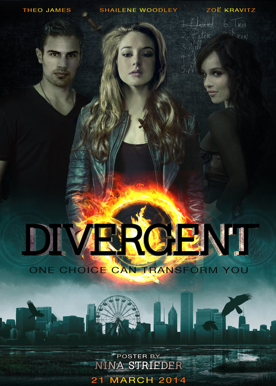
Divergent

Screen shot 2014-03-24 at 11.19.36 AM


Another movie adaptation of a young adult book series based on a dystopian future? To the book’s credit, though, the movie plays it very closely. This movie (and book) follows the trend of movies in the last several years. They present young adults in bizarre or dangerous situations in which they have to make decisions, take risks, and go their own way. Non-conformity in a dystopian future appears to be the choice theme and hottest phenomenon these days. Just a thought…who’s to say that our future will be dystopian? Isn’t it just as likely that society may not be torn by wars of epic proportions or ravaged by zombies? I like to think society will blossom and improve. Oh well.

It’s ironic, if not a little predictable, that movies from books like these are nearly risk-aversive. With your producer breathing down your neck, why rock the boat and jeopardize a potentially wildly successful franchise if you don’t have to? “Divergent” is the latest movie in a long line of similar predecessors like “Hunger Games,” “Total Recall,” “Blade Runner,” yes and even “A Clockwork Orange.” Like in “Hunger Games” and “Harry Potter,” apparently only teenagers or young adults have the courage and honesty to stand up for what is right and challenge the system or order of the current world, which for all we know only consists of a future Chicago that resembles current Detroit.

Though its main appeal will most likely be to those who read the book and are young adults either chronologically or in spirit, “Divergent” does have something for the rest of those who will undoubtedly watch it; and that’s the chance to see the pair of performers who make that romantic music together. An early choice to play the lead, Shailene Woodley who plays Tris (hmm…where have we seen an underdog female protagonist in a dystopian future before?), is one of her generation’s most beautiful and promising young female actors. Picking her soul mate took a lot longer, but the studio’s selection of the devastatingly handsome Theo James to play Four has paid off. Both the actors have excellent chemistry on screen and serve as a glue for the film.

Although I have not read the book, from what I have been able to research, except for some minor nips and tucks, the screenplay follows the book fairly closely. The biggest change is the further development of the Machiavellian Erudite leader Jeanine Matthews, well played by Kate Winslet, into full-fledged villain status. However, her character’s position is unable to elicit empathy from the audience. And, an audience empathizing with the villain is important in a well-written story. Furthermore, the cause for the takeover by the Erudites (one of five main factions) is never fully explained.

Cinematography and editing wise, the film has a very instagram look; but, that is not entirely uncommon for these types of films. It was refreshing to venture out of the Dauntless caves every now and again to see other colors besides various hughes of black, brown, and red. Regarding the structure of the movie, most movies follow a classic three-act structure. But as the title suggests, this movie “diverges” from the classic structure of a cinematic narrative story. Act one lasts 3/4 of the film, and acts two and three are only 1/8 each. The slow pace in the beginning does pay off with the fast-moving pace in the last two acts.

All-in-all, this movie contains elements that are par for the course in this genre. But a well executed futuristic action-romance film. Definitely one that a family can enjoy together, and one from which young women and men can learn honestly, respect, and courage. A good way to spend 2.5 hours.

Enemy

Screen shot 2014-03-24 at 10.16.24 AM

Screened at the special presentation section at the 2013 Toronto International Film Festival and winner of the Best Picture award at the 2nd Canadian Screen Awards, “Enemy” is a slow-moving psychological erotic thriller starring Jake Gyllenhaal about college professor Adam (Gyllenhaal) who seeks out his doppleganger (also played by Gyllenhaal) after spotting him in an independent film.

The films opens with the phrase “chaos is order as yet undeciphered.” An accurate message to state at the beginning of this film as it lives up to it in spades. It’s artistic, splendidly undeciphered, and full of meaning…I’m just not sure entirely sure what that meaning is. In a psychological thriller, there are often elements that are not explained up front…but isn’t that what makes something suspenseful…the anticipation of what is to come or what the meaning behind something is? The problem with this film is that very little, if anything, is ever explained. The denouement is lacking and leaves the audience wondering “what the (you fill in the explicative).” There is lots of conflict; and any film student worth their weight in salt will can tell you that no well-written story exists without conflict. However, along with the conflict, there needs to be resolution. And, that absence in this film leaves a big gaping hole at the close of the narrative. It is almost as if the movie continues long into the ending credits, but we do not have the opportunity to view it.

The movie opens with a Kubrick style scene that could’ve come straight our of “Eyes Wide Shut” featuring an erotic dancer and a spider. Yes, a spider. This same spider follows the plot and Adam throughout the entire narrative–again, never explained. “Enemy” is the type of film, like a brilliantly orchestrated train wreck, that you can’t take your eyes off of, largely in part to Gyllenhaal’s performances as both men. Both men are the same, yet different. Nearly resembling an avant-garde film from the 1920s, director Denis Villeneuve keeps the film in hues of yellow and black, with dialogue sparsely thrown in. In fact, one could remove the dialog completely and be left with the same final product.

One aspect to developing a visual narrative that “Enemy” does right is engage the open-minded audience members to ponder and theorize explanations long after the film is over. If you are up to an intellectual challenge and enjoy a movie that causes you to think, this movie may be one for you; however, it is not a film for everyone, including the casual movie patron. Perhaps the movie achieved its goal after all: appealing to the artistic and intellectual movie connoisseur.

A Well-Deserved Award

Check out this video of Angela Lansbury receiving her honorary Oscar at the 2013 Governors Awards. She is not only a living legend, entertainment royalty, but a prime example of dedication to one’s craft and finding a place in the heart of millions. From her Academy Award nomination in the film noir “Gas Light” to the voice of Mrs. Potts in “Beauty and the Beast,” not to mention her 12 years as her most iconic character Jessica Fletcher in “Murder, She Wrote,” this award is long-deserved.

Monuments Men

(C)2014 Fox Studios

(C)2014 Fox Studios

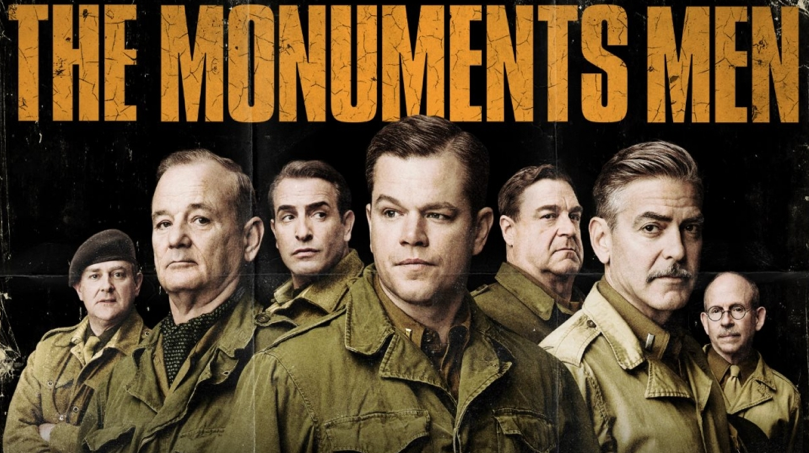
The movie “Monuments Men” chronicles the greatest art heist in history. Taking place at the end of WWII, the film is about a group of men, with assistance from a woman in France, who are tasked with the responsibility of locating, protecting, and recovering Europe’s ancient and Renaissance irreplaceable treasures, including the Bruches Madonna and the Ghent Alter.

Although the movie possessed an impressive pedigree of actors and production value, it was lost between tones and genres. One of the main problems is that fine art and action simply don’t go well together. As a result, Clooney ends up stranded in some no man’s land between joshing Robert Aldrich-style action movie, rousing Second World War epic and essay in sappy art-history nostalgia. The screenplay failed to establish one of the most important elements in a well-written screenplay–having a well-defined and developed central character (or protagonist). It’s a perfect example of why an ensemble cast simply does not work; furthermore, it’s very difficult to do each of the characters justice. There are many moments in the movie in which this ragtag band of men are gazing in awe at a Michelangelo or Picasso one monent, and fighting to the death with Nazis the next.

Even though the audience may be asking Clooney to wake them up when he and his band of merry men find the art they are looking for, that is a harsh assessment of a film whose heart is in the right place–the “story” is fantastic–but, having a good heart alone does not a good film make. Due to the all-star cast, including Hollywood royalty like John Goodman and Bill Murray, the film is a throwback to the post WWII era films that were released about 15-20 years following the close of the war. Such films were aimed at a morally exhausted U.S. audience that wanted to be congratulated for its role in ending tyranny; but also wished to be entertained by a caper, romantic story, or drawing room humor. In order to have accomplished this, the screenplay should have elaborated more on the no-so-romantic relationship between Cate Blanchette and Matt Damon’s characters. As it stands, the time spent on the romance-that-will-never-be between them could have been spent elsewhere.

If you’re looking for beautiful cinematography of fine art, you will find it in the movie. The movie does a great job at bringing the audience as close as many will get to these masterpieces. And, it will feel like an art history class that is actually fun and interesting for the more educated audience who is undoubtedly the ones buying tickets to this movie. Another accomplishment of the movie is that it highlights a story that many did not know existed and shows the world how important art is. In an age in which schools are pushing their STEM (Science, Technology, Engineering, & Mathematics), it is refreshing that a movie advocates the support of the arts.

Looking for the next historic tear-jerking blockbuster, this movie is not it. But, if you are looking to learn more about this special operation during WWII and be mildly entertained amongst the action, then this is a great way to spend a couple hours.

OSCARS–86th Annual

(c)2014 Academy of Motion Picture Arts and Sciences

(c)2014 Academy of Motion Picture Arts and Sciences

I don’t know about you, but for those of us who are involved in or passionate about the visual and performing arts, the annual Academy of Motion Picture Arts and Sciences Award Show, or the Oscars, is nearly as important as a New Years celebration. And, many of us treat is as such with parties, food, cocktails, and spending time with equally passionate friends. The Oscars is seen as the most important award show in the film industry; it nearly overshadows the press and attention the Golden Globes, Screen Actors Guild, and People’s Choice award receives, as well as others. If you’re looking for a   monday morning quarterback replay of last night–who should and shouldn’t have won–this review is not for you. This review seeks to cover the show itself.

Prior to entering into the grand house at the Dolby (formerly Kodak) Theatre, ABC covers the telecast of the Red Carpet events. Robin Roberts was beautiful as always, and did an excellent job as both a television host and journalist covering the red carpet festivities. We certainly saw some fashion do’s and don’t. But we will save that debate for another time. It was an encouraging step in the direction of attracting younger viewers to the events, which last year had a median age of 51.4, by connecting to viewers by way of the Twittersphere. Over the last few years, the median age of the television audience keeps climbing. Uploading celebrities photos from the red carpet to Twitter engages a younger audience, which the Oscars needs to do to stay viable.

According to the “Hollywood Reporter,” As a television event, this year’s Oscars was more like an endurance test — turgid, badly directed, poorly produced and featuring an endless string of tired or wince-inducing moments from host Ellen DeGeneres. But, other than being too long, the show was entertaining, lighthearted, and included lots of quirky humor from Ellen DeGeneres, this year’s host. Playing it safe after Seth MacFarlane last year, the Oscars producers Craig Zadan and Neil Meron, went back to using a previous host. Ellen last hosted in 2007. Knowing that Ellen hosting would not pickup the younger audience the Oscars needs to pickup, the show writers desired to bring the show into the 21st century. And, they succeeded in doing this by involving the Twittersphere heavily. Although at times it felt more like a reoccurring Samsung ad, Ellen was able to take these otherwise untouchable people, and bring them closer to the people who make them famous–their fans. The selfies exploded on Twitter and I think that is what the Oscars needs to do to keep up with society. Appearing the audience multiple times, and even jumping up behind Leo, Ellen brought you as close to the celebrities as most people will ever get to be (aside from watching them in a movie). It makes the celebrities seem like real people–and that’s a good thing. The funniest and most bizarre event of the evening was the actual appearance of the pizza, after Ellen joked about pizza earlier in the show. That delivery guy will never forget this the rest of his life. Ellen was successful in bringing a true sense of off-the-cuff humor to the show.

What about those speeches? Now, this blog will not debate who has the best or worst speech, but there were definitely some speeches that were way too long, and others you wanted to hear from but couldn’t get a word in edge wise. The producers of the Oscars need to better define the length of speeches in each category. Other award shows limit the time a recipient has, and the Oscars should follow in suit.

The theme this year was a little incoherent at times, and was definitely something that could’ve been ditched to save time. The theme, of course, was heros. No, not American military, law enforcement, or first responders, but movie heros. Simply stated, there was no need to take up the award show with so many montages of movie heros. Without timing all the hero montages or speeches about heros, it stands that a significant of time could have been saved by just sticking to what the theme should be, which is honoring the best in film. Isn’t the whole reason the show exists reason and theme enough?

Finally, like with any award show, there are several performing artists that take the stage to, if for no other reason, than to break up the monotony of watching presenters and recipients. This year, each song nominated for “Best Original Song” was performed live by the artist who performed the song for the movie. Although “Let it Go” won the award, “Happy” was the better live performance at the Oscars. Pink’s performance during the tribute to the “Wizard of Oz” was outstanding and brought tears to the eyes of Judy Garland’s children. The highlight of the musical performances was Bette Midler’s “The Wind Beneath My Wings.” She did an excellent job! Like Streisand’s “The Way We Were” last year, Midler’s performance added a touch of class to the show during the memorandum segment. Another time saver, for the producers, would have been having Midler sing during the slide show like Pink did during the ‘Oz” segment. If you didn’t catch it, 2nd AC Sarah Jones did receive recognition for dying on set in a lower third following Hofman’s slide. Speaking of the placement of Philip Seymore Hoffman, due to the reason he died of a drug overdose, it would have been classier and more respectful to have ordered him in the middle and Shirley Temple-Black’s slide should have been the final one, since she was the original child star.

Over all, the Oscars was long but very much entertaining and enjoyable. Ellen successfully used her quirky humor and ability to connect with audiences to effectively make the Oscars the most enjoyable it’s been in years. Seeing Hollywood royalty like Kim Novak, Sydney Poitier, and Bette Midler. And, it was wonderful to see that Angela Lansbury was the recipient of one of this year’s honorary Oscars for her lifetime of achievement in entertainment. Congrats to all the nominees and winners!