The Woman in Black 2: Angel of Death

WomanInBlack2

Return to the infamous Eel Marsh House in The Woman in Black 2: Angel of Death. This less terrifying sequel to the original neo-classic horror film is a fun horror movie to watch with friends. Like the previous installment, this film evokes memories and feelings of classically structured horror films. Although there are narrative issues and unanswered questions, this film hits the mark for creating an eerie feeling throughout the movie. To my pleasant surprise, the jump scares from the first movie are all but left out from this installment; however, there are some scary moments that are reminiscent of the original that are used effectively. This film is one that would have benefited greatly from being shot in greyscale (black and white) like the classic horror movies of the 1930s and 40s. With the camera changing from objective to subjective shots, it’s sometimes unclear whether the audience is watching the characters or looking through the eyes of someone more sinister, but that is part of what gives the movie its suspenseful flare.

The Woman in Black 2: Angel of Death is about a group of orphaned evacuees from London during the time of the bombings of World War II. Led by Jean Hogg (Helen McCrory) and Eve Parkins (Phoebe Fox), the children are brought to Eel Marsh house in the British countryside where they awaken the vengeful spirit of Janet Humphries once again. Having to face both the ghosts of the present and the ones from her past, Eve teams up with handsome pilot Henry (Jeremy Irvine) to discover the reason Janet has her eyes fixed on the recently orphaned Edward.

This is very much hit or miss horror film. Some fans of the original are definitely going to like it, and others are going to feel as if they wasted an hour and a half that could have been spent in another movie. In an effort not to spoil some of the plot for those who have not seen it, I won’t spend time on material that may give away some of what should be a surprise. BUT, there are definitely some plot points that were severely left undeveloped and should have been worked into the story much more effectively. As far as the acting, it is on par for this style of horror film, but is not nearly as good as acting Daniel Radcliffe was able to deliver in the previous movie.

As is a standard in classically structured horror films, this one comes complete with a light romance story between Eve and Henry. Thankfully, it is carefully worked into the plot in such a way that it is both believable and plays an important role towards the close of the movie. (Slight spoiler alert) Shockingly, this film did not hold back on placing children in perilous situations. Ordinarily, horror films featuring children do not often show children dying but this one plays that card very well and strikes a good balance.

Ultimately, The Woman in Black 2 fails to provide general audiences with a successful sequel to the original movie. Perhaps, had the studio shot the film in black and white, the film would have been better received. Underdeveloped characters, subplots, and a slow pace hurt this film and prevent it from appealing to most fans of horror. On the other hand, fans of the original or the book upon which the series is loosely based will likely enjoy this film.
Big Eyes

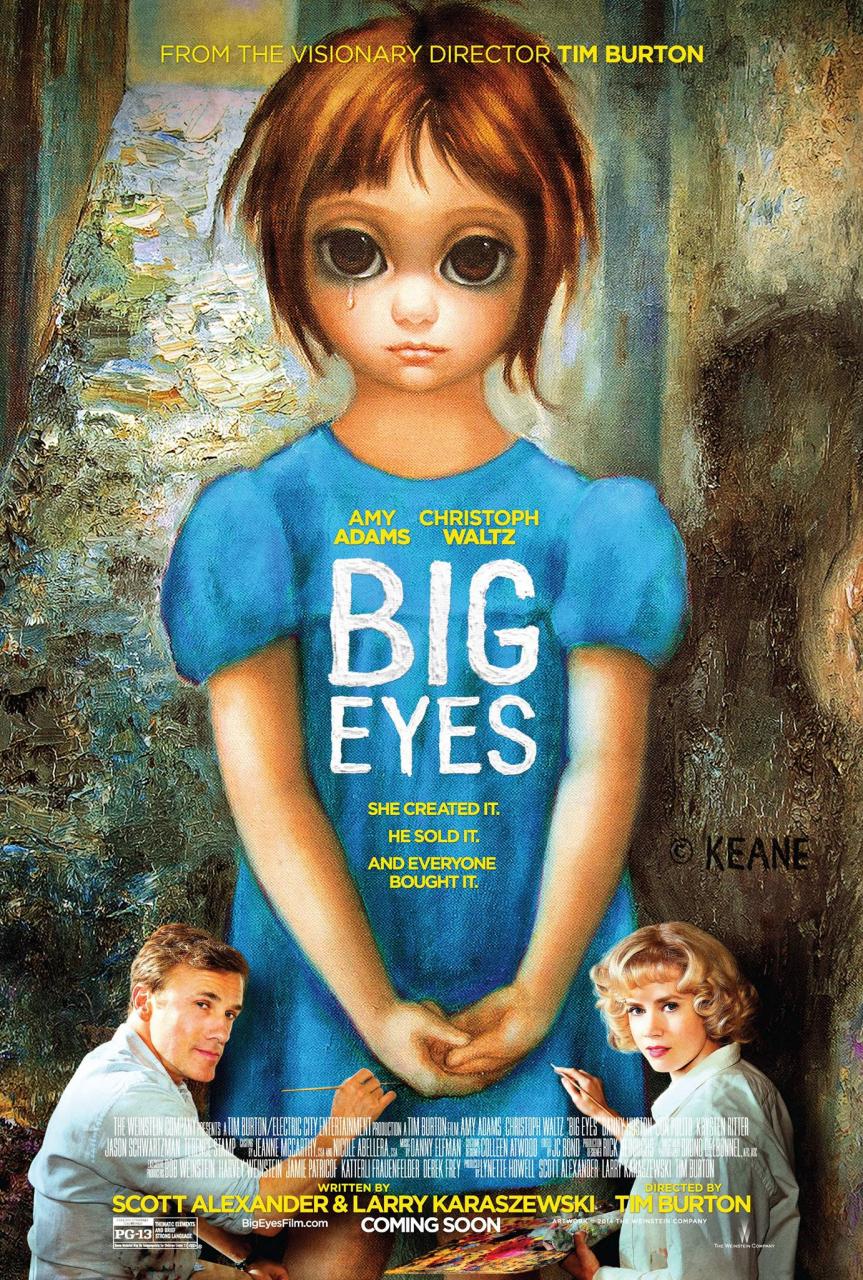
Big EyesOver the decades, there are movies produced that act as commentary on the state of politics, socio-economics, and sometimes humanity itself. And that is exactly what visionary director Tim Burton has done with the artful film Big Eyes. If you have ever had your creative work stolen by someone else, or taken part in or perpetuated a lie for so long that you begin to believe it yourself, then this is a movie for you! Although not blatantly “Burton” production style, the subtleties of his genius are meticulously woven throughout the film. Amy Adams and Christoph Waltz are brilliant together and genuinely sell their respective characters. For fans of Don’t Trust the B!&@h in Apartment 23, Krysten Ritter makes several cameo appearances that are reminiscent of Chloe. Not a deep story, but this is a narrative that is extremely well executed, funny, and is a testament to authenticity and honesty. For those who have ever felt vulnerable or helpless, then you will likely find inspiration in this film.

Based on a true story, the movie Big Eyes depicts the the evolution of one of the most popular art empires during the mid 20th century. “In the late 1950s and early ’60s, artist Walter Keane (Christoph Waltz) achieves unbelievable fame and success with portraits of saucer-eyed waifs. However, no one realizes that his wife, Margaret (Amy Adams), is the real painter behind the brush” (IMDb). A double-edged sword, Walter’s discovery of Margaret’s works would be both a blessing and a curse. Although Margaret is first horrified to learn that Walter is passing off her work as his own, she is too meek to protest too loudly; but she actually helps to perpetuate the lie and even begins to believe it herself. It isn’t until the the Keanes’ marriage comes to an end and a lawsuit follows that the truth finally comes to light. Follow Margaret on a journey that takes her from vulnerable single-mother to protective mother and finally proud artist.

When coming to the theatre to watch a Tim Burton film entitled Big Eyes, one might expect that there would be crazy big eyes throughout the film and the production design would reek of abstract impressionism. But, that is definitely not the case with this movie. There is only one scene that reeks of the classic Tim Burton style we have all come to expect most of the time from such a visionary. The overall production design is quite simple and typifies what middle and upper class life was like in the U.S. in the 1950s and 1960s. Everything from the Edward Scissorhands neighborhood in the opening to the retro A-frame house design later on in the film is reminiscent of architecture in the mid 20th century. The use of vibrant colors in the production design helps to set the artistic mood of the narrative. The colors also assist the visual storytelling of the film by matching the mood of various scenes.

Probably the best parts of the film are the casting and acting. Adams and Waltz are absolutely perfect for their respective roles. The degree to which Waltz sells his charming, manipulative, manic, psychopathic character is outstanding. There is even a moment in the movie where he totally goes “Jack Torrence” on his wife and step-daughter. This moment is right out of Stanley Kubrick’s The Shining. But, my favorite scene has to be the one in which he is both the defendant and attorney in the court-case that is the center of the movie’s showdown. His antics are crazy, funny, and extremely entertaining. Adams plays her mousy, meek, vulnerable, motherly role with excellence. Although her character lacks the charisma of Walter, she plays her character so convincingly. She possesses the skill to both communicate her acceptance and reluctance to perpetuate the lie that is the crux of the film. Krysten Ritter shines as Margaret Keane’s best friend DeeAnn. She really was the perfect choice for the role that harkens back to her character of Chloe in Apartment 23. All the characters have amazing chemistry on screen, and it truly supports the creative narrative.

The movie is also a strong depiction of commentary on humanity in and of itself. It shows the audience how a small and innocent lie can snowball into a lie so large that it is eventually the undoing of an entire empire. Often times, a lie has to be told to cover up a previous lie, and if one does this long enough, one can very well begin to believe the lie to be true and lose sight of reality or the truth. Interestingly though, it is easy to see and understand why Walter does what he does in the film. It can be argued that if he hadn’t stepped in to sell Margaret’s artwork, that she would still be an undiscovered artist underselling her art on the sidewalk. At one point in the movie, it is quite apparent that even with celebrity, Margaret still cannot sell her artwork and is dependent on Walter’s smile, charisma, and brilliant sales mind. I still find myself thinking about character backstories, rationale, and decisions long after the movie is over.

Perfect for art lovers and anyone who loves to create, sell, or critique. This movie is a wonderful addition to the list of movies you may want to see this holiday season.

The Interview

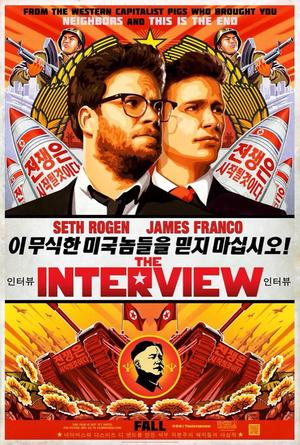
The InterviewSome of the most successful theatrical comedies are those that take risks, and that is exactly what Sony Pictures has done with The Interview. If you were disappointed that Regal, AMC, Carmike, and other high profile movie theatre chains decided not to carry the film and Sony (parent company to Columbia Pictures) refrained from releasing it on DVD/BluRay, you can catch it on Google-Play. James Franco and Seth Rogen are a hilarious match with fantastic comedic chemistry. Is the movie irreverent? Yes. Is it offensive? Yes. Was it well structured, paced, have memorable characters you either love or love to hate, and well-acted? YES. In other words, this film is a very well executed comedy that, in the words of The Magic School Bus’s Ms. Frizzle, “takes chances, makes mistakes, and gets dirty!” Comedy is drama in disguise, and this concept is well played-out in this political comedy that will have you rolling in your seats and laughing out loud with your friends.

The Interview is one part self-reflexive movie and two parts political, satirical comedy starring Seth Rogen as the veteran television producer Aaron Rappaport of the TMZ-ish talk show Skylark Tonight hosted by Dave Skylark played by James Franco. After receiving word that the Democratic People’s Republic of North Korea’s supreme leader Kim Jong-un is a huge fan of the show, Rappaport and Skylark decide to conduct the interview. Using this as an opportunity to assassinate the oppressive leader of North Korea, the CIA approaches the two media professionals with a plan to poison the reclusive leader in order to free the nation and protect the United States. Follow the uptight television producer and his eccentric host on an unexpected journey filled with espionage, intrigue, and laughter as Skylark prepares for his most important interview of his career that could have major repercussions in the world.

Ordinarily, I am not a huge fan of comedies. However, every once in a while there comes a comedy that is well-executed all the way around. The Interview is the type of movie that will likely develop a cult following because of the simple fact that is was essentially kept from public exhibition, but it truly has a lot to offer. Furthermore, it is also excellent commentary on how to work through political upheaval and strife between nations. The self-reflexivity of the movie is evident in the production of the Skylark Tonight show because the audience gets a taste of what it is like for a national television show to prepare for a high profile interview of a country’s dictator. A little bit of the curtain is pulled to see how questions are developed and arranged, and how manipulating the format can have great implications for the results of an interview.

Throughout the movie, there is so much satirical political comedy that it will be hard not to laugh. From the faux celebrity interviews to the master plan of the CIA, from the security guards to the supreme leader himself, this screenplay is filled with situations that are simply laughable. Not laughable in that there is no rhyme or reason to the plot, but for the reason that it is woven together in a manner that greatly supports the narrative. Timing of comedic content is key to a successful movie such as this one, and the writers did their job very well in laying out the jokes and humorous messes in which the characters find themselves.

If you enjoy political satire or self-reflexive comedies, then this is a movie that you will undoubtedly enjoy. Much of the content is for mature audiences only, so it definitely isn’t the movie you play for family movie night. And yes, a large portion of the irreverent comedy is at the expense of Kim Jong-un, so it is of no surprise that Sony decided to release it online instead of in theaters. However, I feel it could have been a smash hit with audiences this festive season when so many are getting together with friends and family to enjoy the laughter that comes along with the holidays.

Unbroken

Unbroken

Unbroken is an incredible journey through the life of Louis Zamperini. It is a superbly inspirational film that will be sure to touch everyone who watches this extremely cinematic war-time masterpiece that harkens to classic Hollywood story structure. Based on the best-selling novel by Laura Hillenbrand, this film is truly one of the most gut-wrenching war-time movies. Angelina Jolie showcases her talent for the directing chair, and it is evident. Although there are elements of the story which could have been executed better, the greatness of the narrative outweighs them. This is one of those movies where there is nothing overtly wrong with it, but at the same time, there isn’t anything technically outstanding about it either–with the exception of a compelling screenplay, exquisite acting by Jack O’Connell, and a realistic depiction of what life in a Japanese prisoner of war camp was like. It is sure to garner Oscar nominations and quite possibly some wins as well.

“As a boy, Louis “Louie” Zamperini is always in trouble, but with the help of his older brother, he turns his life around and channels his energy into running, later qualifying for the 1936 Olympics. When World War II breaks out, Louie enlists in the military. After his plane crashes in the Pacific, he survives an incredible 47 days adrift in a raft, until his capture by the Japanese navy. Sent to a POW camp, Louie becomes the favorite target of a particularly cruel prison commander” (IMDb). Follow Louie as he holds fast to wise words imparted to him by his older brother, “if you can take it, you can make it,” and does not break or lose faith under the abominable treatment by the Japanese during World War II. Many years later, he then returns back to Japan forgive his captors. Finally, in 1998, Louis fulfills his dream to one again run in the Torch Relay in the Olympic Games hosted by Japan.

The most incredible element of this movie, beyond the story in and of itself, is the amazing and authentic acting by Jack O’Connell, who plays Louis Zamperini. He truly possesses the ability to convey genuine pain and anguish. And, unlike many nearly super-human stories like this one, he also shows that he struggles with decisions and emotionally breaks down from time to time. As unreal as his ability to remain “unbroken” is to the audience, he is also very real emotionally, psychologically, and physiologically. This humility and earthy-ness of Zamperini allows almost anyone in the audience to identify with his struggles. Most likely, very few in the movie-going audiences would have had experience in war, or even less likely, as a prisoner of war. We all go through extreme trials of the mind or body and can learn from Zamperini to not break under undue or unfair pressure. Stay true to what you believe in and your goals.

The opening of the movie is a memorable throwback to classic Hollywood wartime movies with expansive aerial views and the hum of the propeller-driven aircraft engines. The movie remains here only for a short while before flashing back to Zamperini’s life as a child. Starting out as a petty thief, his family desired for him to become more. After being busted by the local police a few times and thanks to the guidance of his older brother, Zamperini refocuses his energy on becoming a star runner for his school. This is where I feel the screenplay could have improved the storytelling. Flashbacks are seldom a good idea. It would have been much more pleasing to the pace and structure of the narrative to have just started the movie out with Zamperini as a child and told the story from there. This would have allowed for the audience to witness the building up Louis’ character from selfish thief to a steadfast soldier with genuine integrity and a love for his country and comrades. Although his character is unyielding during the movie, there lacked true development or character arc. He went from thief to hero much too quickly. Even though the majority of the movie dealt with his life as a POW, it would have been better to have added more story concerning his family and the US as they battle Japan. This would have helped to break up the monotony of spending so much emotionally draining time at the camp, because the material is so very heavy.

Over all, this movie is very well directed, written, edited, shot, acted, and scored. And, there is a little bit of humor prior to Zamperini’s internment at the camp. There is even a moment that feels like it is right out of Jaws and an extremely funny Hellen Keller joke. Although some more lighthearted material would have been nice to alleviate the heavy and dark cinematic material, it is understandable why that could have prohibited the movie from touching people as much as it does. After the narrative failure of Fury, I was wondering if Hollywood could provide us with another Saving Private Ryan, and Universal Pictures accomplished just that with this wartime masterpiece for a new generation.

Into the Woods

Into the Woods

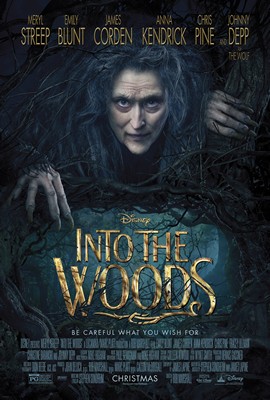
I wish…more than anything…more than life…I wish Disney hadn’t worked extra hard to nearly ruin such a beloved show. I knew from the onset of the then-rumors of Disney’s acquisition of the film rights to the Sondheim-Lapine masterpiece, that they ran a risk of mutilating a show’s plot in order to make it more kid-friendly. And, just like the forbidding words of the Soothsayer in Julius Caesar, the worries over this production came to pass as nearly predicted. This is supposed to be a satirical FUNNY stage show; however, nearly all the funny was sucked out of the film adaptation that’s oddly enough already received Golden Globe nominations. The first act is adapted to the screen well enough; but the second act was essentially rewritten–and rewritten badly. If this is the direction that movie studios are moving when adapting smash hit Broadway musicals, then please leave the shows intact on the stage where they can thrive.

Stephen Sondheim and James Lapine’s smash hit Broadway musical comes to the screen by Walt Disney Studios and directed by Rob Marshall. The film is about several fractured fairy tales including Cinderella, Jack and the Bean Stalk, Rapunzel, and Little Red Riding Hood woven together with a story about a barren baker and his wife who have been cursed by a witch. The baker and his wife are sent on a mission to bring four items to the witch in order to break the curse. Searching for four items in the mystical woods will bring different fairy tale characters together in a tangled web of lies, deceit, bribery, and death. Filled with beautiful musical numbers and iconic characters, this film takes on the daunting task to bring the beloved musical to a theatre near you.

There have certainly been successful film adaptations of wildly popular and long-running Broadway shows. And, sometimes, the film adaptations are better than the stage shows because of the addition of the camera, visual effects, and editing. Some examples of film adaptations of musicals that are arguably better than the originating stage productions are: ChicagoMamma MiaFunny GirlLes MisérablesAnnie (and no, not the present incarnation), and yes I’m saying it Phantom of the Opera. However, Disney’s Into the Woods will not make that list. But, it could very well make the list of worst film adaptation of Broadway musicals. For fans of the original show starring the incomparable Bernadette Peters as the Witch, the first half of the movie is pretty well in line with Act I of the show, only missing the entertaining and funny witch, the Baker’s father’s humorous antics, Godmother’s extended dialog, the sexual tension between Red and the Wolf, the playful nature of the Wolf–wait–that’s a whole lot of important material left out. Well, once you get a load of the second half of the movie, you will understand why the first half can be seen as close to the original.

The second half of the movie is barely a shadow of its stage counterpart. With very few elements of the second act from the Great White Way remaining part of the film adaptation, Disney essentially reimagined the second half of the film to create a new less memorable or endearing story. The pace of the second half of the movie is way off-step, the story structure is abominable, and the characters are not endearing. Although, it may have added a few minutes to the running time of the movie, the eliminated songs and subplots that were removed in this mashup of fractured fairy tales could have helped to bolster the appeal of the second half. Again, this is supposed to be a funny story. I seldom laughed during the movie.

And, let’s talk about the white elephant in the room–Meryl Streep’s Witch. Let’s just say that Streep, for all her accomplishments–and I genuinely believe her to be the greatest female actor of all time, she cannot hold a candle to Bernadette Peters. Peters made the original show with her voice, antics, humor, and effervescence. Streep plays the Witch much darker and far less playful. Although the film was cast pretty well, the screenplay and direction failed to inspire the screen actors to live up to the bar set by the original Broadway cast.

Receiving mixed reviews and a moderate ranking on IMDb, Into the Woods is a failed attempt at translating a Broadway show to the silver screen. The only positive consequence of this production is quite possibly opening up the world of Broadway musicals to a new generation. There has been an increase in screen musicals in recent years: everything from Fox’s Glee to the new film version of Annie, and it’s wonderful to witness musicals becoming more popular and touching people that may not have otherwise given a musical a chance. But, if a timeless show is going to be adapted to the screen, the movie studio undertaking the task should keep the soul of the stage show alive on the screen instead of rewriting it.