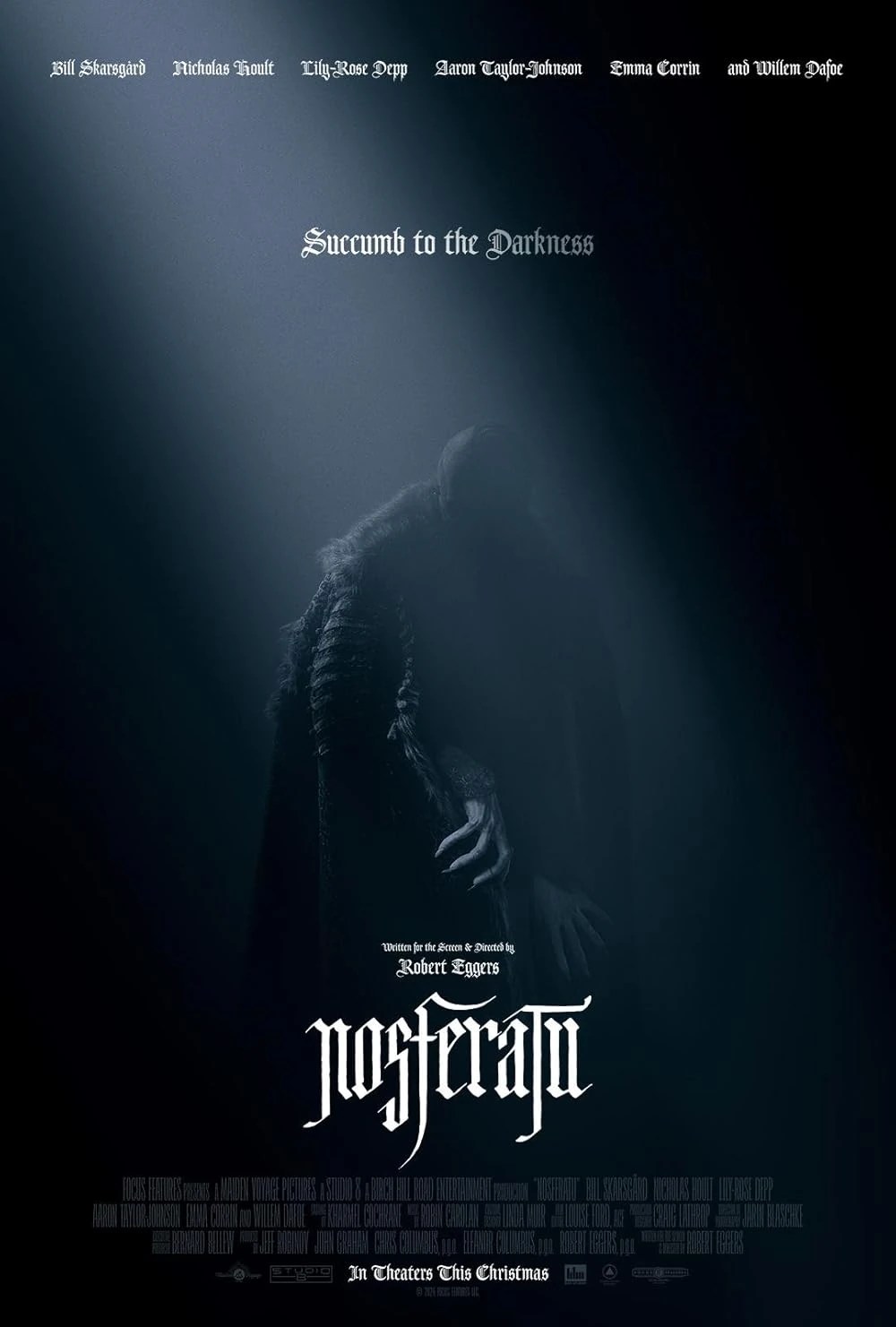
Gothic horror is truly timeless. Universal is going back to its roots in horror with its latest motion picture. More than a century after F.W. Murnau gifted us with the original Nosferatu (1922), director Robert Eggers delivers audiences his take on Murnau’s unauthorized Dracula adaptation; however, Eggers’ vision for his expression of Nosferatu is more closely aligned with Warner Herzog’s Nosfertatu the Vampyre (1979) than with Murnau’s original film. Ostensibly, Eggers’ adaptation sets out to bridge elements of both the 1922 and 1979 versions, whilst incorporating the postmodern ideologies that he has integrated in his past works. This expression of Nosferatu combines the atmosphere, mood, and settings from the 1922 version with the characters and erotic tone of Herzog’s version. Each iteration of Nosferatu reflects its director’s vision and the cinematic sensibilities of its time. For it was Oscar Wilde whom reminded us that all art is self-portraiture, “Every portrait that is painted with feeling is a portrait of the artist, not of the sitter.” As cinema is art, and the director is often considered the author thereof, then each of these versions expressed something to us about his beliefs, fears, anxieties, or worldview. Eggers took the expressive techniques and vampire lore of Murnau, the existentialism and romanticism of Herzog, and combined those with his applied postmodernist worldview to create 2024’s Nosferatu.
In the 1830s, estate agent Thomas Hutter travels to Transylvania for a fateful meeting with Count Orlok, a prospective client. In his absence, Hutter’s new bride, Ellen, is left under the care of their friends, Friedrich and Anna Harding. Plagued by horrific visions and an increasing sense of dread, Ellen soon encounters an evil force that’s far beyond her control.
Egger’s expression of Nosferatu demonstrates a desire to explore themes of mortality, isolation, corruption, and desire all while underscoring each theme with a sense existential dread. The primal fear of death is perhaps the most overt theme, because Orlok represents the lengths people will go in order to escape that which is inevitable. While monstrously depicted in the film, there is a parallel here between that and the obsession people can have in the real world over youth, vitality, and longevity. We can even draw further parallels between the desire vampires have for human blood with the desire humans have for medications and medical procedures that claim to prolong life and youthfulness.
A recurring there of vampiric imagery is obsession, not only with youth and life, but obsession in connection with desire—specifically primal desires for that which appears or feels forbidden. Long since has the vampire been used as a personification of forbidden desires. While this was particularly true in the Victorian era—what with its many romantic and sexual mores—it can also be seen today by some as the informal boundaries that Western culture places upon depictions of romance and sexuality. In the postmodern era, many feel that the Eastern ways of life are more liberating, and that is represented in the fact that Orlok hails from Eastern Europe (presumably in the area of Transylvania).
Our central character of Ellen (which is a switch from the typical male central character in variations of the Dracula story), represents the idea that some women feel confined by the boundaries placed upon them by a patriarchal society. By Eggers’ endowing the character of Ellen with a greater sense of agency, he is able to convey more focus on the confines of the Western and/or patriarchal world upon the primal desires of Ellen, and how she must overcome the ties that bind her to both written and unwritten societal expectations. In turn, Orlok can be read as the means to free oneself from all societal inhibitions, but that liberation comes at a great cost. Ellen’s desire for Orlok is both attractive and repulsive—she wants what he represents but doesn’t want the monster himself. In the end, the only way to save her town of Wisborg (and world) is by giving into her primal desires as a means of sacrifice.
One of the biggest differences in both previous versions and Eggers’ is the imagery of Count Orlok himself. In both previous iterations, there was something sympathetic, darkly whimsical, and even suave about the Count; but in this version, Count Orlok is exponentially more monstrous looking, which offers a stark contrast to that of the alluring appeal of the vampire. Interestingly, Eggers’ interpretation of a vampire is much more closely aligned with traditional eastern European folklore than the words and descriptions of Bram Stoker. Reaching beyond the Dracula novel and both previous versions of Nosferatu, Eggers set out to create an interpretation that demonstrated concern for historical detail and traditional folklore to give his version a sense of realism. Unfortunately, this realism is somewhat hampered from beginning to end, given the film takes place in Germany but none of the characters speak with a German accent, much less in Deutsch. But I digress.
Another difference between this Nosferatu and past versions of both Nosferatu and Dracula is the absence of consistent religious iconography or ritual. Even our esteemed Dr. Albin Eberhart (played by Willem DaFoe) incorporates Western medicine, Eastern medicine, and religions from around the world in his cocktail of methods for healing Ellen and vanquishing Count Orlok. This can be read as Egger’s commentary on how all religions are variations of the same thing, and that the best parts of each can be used in dealing with the obstacles of life. In many ways, this is a reflection of the views many have of religion and tradition in a postmodern world—the strength of a religious practice is in the belief itself and not in the person or object at the center of it. Interestingly, however, in contrast to the views many have of evil in a postmodern world, the movie posits the idea that there is evil in the world, and it isn’t a matter of perception or opinion—that there is evil out to devour all good and innocent in the world. What I appreciate about the character of Dr. Eberhart is his views that science and religion are not mutually exclusive; his character demonstrates that both science and religion are two sides of the same coin, and we need both in our lives.
Like with Eggers’ past work, this one too suffers from the same lack of thoughtful plotting that plagues his other films. Whether we are talking The Witch, The Lighthouse, or The Northman, Eggers demonstrably places far more emphasis on atmosphere, production design, and cinematography than he does plotting or character development. In fact, the original Nosferatu demonstrates stronger plotting despite the lack of spoken dialogue and title cards. This remake is yet another example of the shortcomings of prestige horror—focusing on how everything looks versus how it is written and plotted. Moreover, this continues to be a problem I have with many (if not most) writer-directors—the lack of strategic checks and balances. When the writer is also the director, then there isn’t usually someone that is part of the preproduction of a film that is in a position to state that something works on paper that doesn’t work on screen, or something that looks great an screen doesn’t make sense for reasons of storytelling mechanics. While I have many reservations for the demonstrable trends in postmodern horror, I will say that prestige horror works more effectively as the equivalent of the type of art that hangs in a museum beckoning for guests to sit in front of it for hours, contemplating that which is being conveyed by the collection of images.
Ryan is the general manager for 90.7 WKGC Public Media in Panama City and host of the public radio show ReelTalk about all things cinema. Additionally, he is the author of the upcoming film studies book titled Monsters, Madness, and Mayhem: Why People Love Horror. After teaching film studies for over eight years at the University of Tampa, he transitioned from the classroom to public media. He is a member of the Critics Association of Central Florida and Indie Film Critics of America. If you like this article, check out the others and FOLLOW this blog! Follow him on Twitter: RLTerry1 and LetterBoxd: RLTerry
 R.L. Terry ReelView