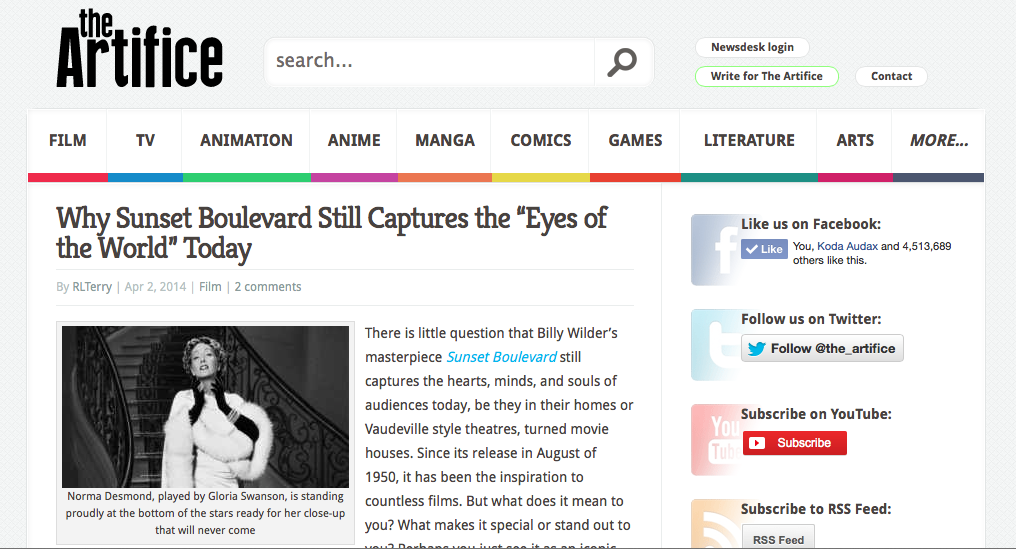
Check out this article I had published on “The Artifice.” Click the link! The name of the article is Why “Sunset Boulevard” Still Captures the “Eyes of the World” Today

Check out this article I had published on “The Artifice.” Click the link! The name of the article is Why “Sunset Boulevard” Still Captures the “Eyes of the World” Today

(c)2014 Fox Searchlight
One of the most enjoyable movie experience of the year! “The Grand Budapest Hotel” has something for everyone. From highbrow quirky humor to brutal murders; from mystery to romance. Surface level, you have a classically written whimsical caper, in the vein of “Clue;” but beneath the surface lies excitement and adventure! The story is about hotel concierge Monsieur Gustave (Ralph Fiennes) who teams up with his newly hired lobby boy Zero Moustafaone (Tony Revolori) to prove his innocence after he is framed for the murder of one of his wealthiest regular guests.
His eighth feature, this latest Wes Anderson film will delight nearly anyone who chooses to darken the doors of the theatre auditorium. Yes, even those who are inclined to grumble at his whimsical cinematic style, both in terms of dialog and cinematography. The movie has a way of charming even the most incorrigible creatures–probably that date you brought. Throughout the movie, there are many situations in the plot that are so ingenious that you will likely roll you eyes at the conceit and lavish imagination that has been woven so intricately into every nook and cranny. However, you will chuckle to yourself, if not laugh out loud a few times. Probably one of the funniest, and uniquely Wes Anderson, moments in the movie is when the prison inmates are using tiny tools smuggled in by way of decadent pastries to tunnel out of the Alcatraz style prison in the Alps.
Probably the most striking element of the movie is the distinct visuals that only a Wes Anderson movie can provide. The art direction and cinematography are two of the elements that stand out the most. His cinematographic style of storytelling is very consistent, filled with very tight shots with plenty of interesting angles. Many shots, he chooses to use, are densely packed with characters and set dressing; and at times, the camera appears to glide along with the characters. Most of the shots in the movie are very static. Ordinarily, this can create a staleness or boredom in a film; but, now with this one. He carefully crafts each shot to give you so much to look at that you forget the shots are not tracking or moving as they do in many films. Interestingly enough, the 4:3 ratio was the primary format used to tell the bulk of the story. I cannot remember another movie that chose to do the same thing for artistic reasons. There are also more classic elements of cinema magic, such as: stop-motion, matte paintings, and rear projection. It’s a brilliant amalgamation of old and new-style cinema to create a unique movie experience for the audience.
Ordinarily, I do not care for a movie where two people sit around, while one of them tells the story that is essentially the movie. And, this one takes that cliche to a whole new level. We start out by witnessing a little girl reading a book that comes to life. We encounter the author of the book who then proceeds to tell the story to his son. Wait, the layers aren’t over yet. Can anyone say “Inception”? Two characters in the story, that is being told by the author, who’s book is being read by the little girl, begin to tell yet another story–the story of the movie you are watching. Did you get all that? I’m not even sure if I did. However, like Jon Avnet, director of “Fried Green Tomatoes,” Wes Anderson is able to create an interested listener in the character who becomes the author of the story of “The Grand Budapest Hotel.” Very few director/writers have been able to accomplish the whole story being told within a story, without it turning out sub par. Under most cirumstances, there is no reason to have two people telling the story which is essentially the entire movie–just tell the main story and be done with it. The dialog is smart and sensible, and each line moves the plot along. Unlike the setting of the movie, the dialog is oddly contemporary–even American. There is no time wasted in the film; moving at an excellent pace, the screenplay keeps your attention the whole time.
This movie is certainly not for everyone–especially those who are already predisposed to disliking Wes Anderson’s style. However, I urge you to try it out. Even the curmudgeon couple sitting next to me laughed along with the movie. The slapstick comedy with an edgy twist to it, will delight and endear the audiences out in the dark. Before you know it, you’ll be laughing at the hijinks and your mouth will water at the very sight of the decadent pastries that are displayed for you. But, don’t forget that you’re actually witnessing a ghastly tale unfold before your eyes. There are many allegorical references and visuals throughout the movie that make it a dynamic cinema experience.
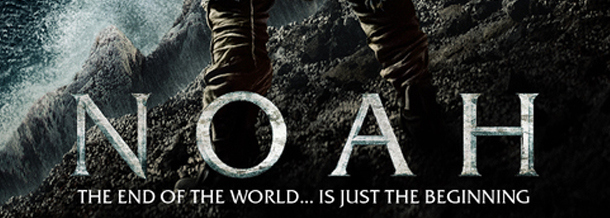
Sweeping cinematography, stunning visual graphics, brilliant editing, powerful acting, and anthropomorphic rock creatures??? Darren Aronofsky’s “Noah” is an adaptation of the Biblical account of the flood as recorded in the book of Genesis. Or is it?
Knowing that the Biblical account is not very lengthy, in order to make a 2+ hour movie out of it, it is necessary to elaborate on the story in order to develop a movie around it. The way an adaptation, cinematically speaking, should be conducted, is starting with the most visual elements and going from there. After all, a movie is mostly visually driven, where as a play is dialog driven, and a book is internally driven. A successful adaptation keeps the skeleton of the story in tact and creates a visual story around it. Very little of the Biblical account remains in the movie, except for the main event. Whether or not you believe the story is history or a legend, you can easily assess that Aronofsky essentially made up his own version of what happened–ignoring most of what little there is, to begin with, in the account in Genesis–and opted for a world of fantasy.
Visually, the movie is fantastic! The beautiful cinematography is enhanced with the spectacular visual effects; combine that with a moving score, and you have the makings of a great movie. Right? Well, maybe. It’s almost as though Aronofsky never even read the story he is adapting for the screen. Regardless if he believes the story or not, he still should have stuck more closely to the text. Not for reasons of proselytizing or preaching the Bible, but for the sake of the integrity of the story. It’s like taking Shakespeare’s works and adapting them into stories so far removed from the original text, that Shakespeare would roll over in his grave. Respect of the source material should be key when adapting a story. Even within the realm Aronnofsky created, elements do not make sense. For instance, the anamorphic rock creatures known as the “Watchers” were defined as fallen angels that cared for Cain following the murder of his brother. According to the widely accepted definition, fallen angels are demons. So, why would fallen angels help mankind? That doesn’t make any sense. And since when is Mesopotamia, where the Biblical account takes place (as well as the “Epic of Gilgamesh”), a barren wasteland? And furthermore, where does Methuselah get his powers? There is much that goes unexplained in the movie. Ignoring the Biblical text all together and simply evaluating the movie in and of itself, there are still problems with the narrative. But, he did show the rain from the sky and water bursting from the earth in a powerful sequence that is closer than other movies have been with the same event.
Now, you may argue that Aronofsky did nothing more than what James Cameron did with “Titanic.” And, most everyone loves or loves to hate the 1997 blockbuster. These are two stories that are easily compared. We don’t know much about the sinking of Titanic, except what is recorded in survivor’s testemonies. And even then, no one will ever know exactly what happened on board or even how the ship split into two pieces. We certainly have no idea if there were a “pair of star-crossed lovers” on board. BUT, there certainly could have been. It is not so difficult to believe that a shipboard romance could have blossomed. After all, shipboard romances blossom on modern-day cruises. Cameron creates a story that is entirely possible, maybe unlikely, but possible. Aronofsky created a story that abandon’s most of the source material and draws radical conclusions of the drama that transpired that do not even make sense within his story. Women don’t become pregnant with the touch of an old man, rocks don’t come to life, and an entire forest does not pop up like a daisy in snow. On the plus side, Aronofsky shatters the idea that the animals came aboard the Ark in a nice orderly fashion 2×2. His depiction of the animals entering the ark is more likely what happened. And, I appreciate that he showed Noah’s family as one that had struggles like any other and probably dealt with fears and apprehensions during the process.
Now, Aronofsky did stick to the text in his sequences about creation, original sin, and the wickedness of man prior to the flood. So, if he could stick to the text with the more controversial issues (creation theories, origin of man, and original sin), how come he could not even come closer to the original text in terms of the story of Noah (which never describes Noah as going all homicidal)? There may not be much there, but what little is there could have easily been included. What we have here is a technical masterpiece of Aronofsky’s account of what he feel may have happened. It’s a visually beautiful story that leaves the audience empty at the end. The plot is like a bucket with holes that cannot hold water. But, the bucket is stunning to behold.
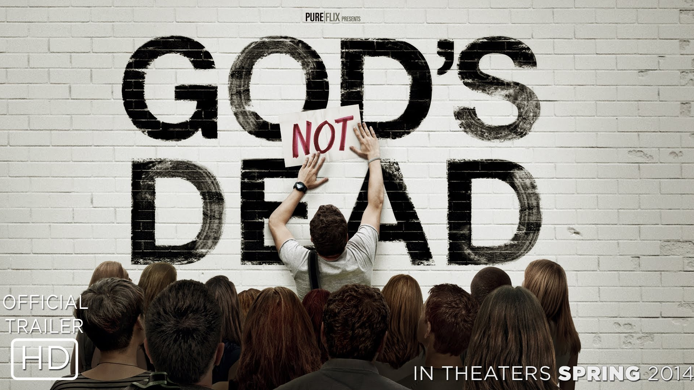
It’s definitely shaping up to be a year in which religious-themed movies are coming out of “Hollywood.” And, “God’s Not Dead” is the latest in a lineup of films including “Son of God” and the upcoming Darren Aronofsky epic “Noah.” Bringing in the money, the movie took the number 4 spot at this past weekend’s opening box office. If you’ve completely missed this movie, it’s of no surprise. The distribution company marketed heavily to churches, religious-affiliated universities, and through their website. “God’s Not Dead” is a narrative drama about a freshman at university in a philosophy class who is challenged to prove God’s existence or risk being failed. Does he prove his argument about God’s existence? You’ll just have to watch and evaluate for yourself.
Usually, acting suffers largely in a Christian film. But, the majority of the performances in this movie were surprisingly good. Shane Harper who plays the protagonist Josh, a freshman at the fictional Hadleigh University in Louisiana (who has purple trashcans like LSU–hmm), does a very good job and gives a solid performance as the student charged with this daunting task. His co-star Kevin Sorbo, who plays the atheistic professor Jeffrey Radisson, gives an equally commanding performance as the passionate and threatened professor. Although, one of the most powerful performances in the movie is delivered by Trisha Lafache’s character of Amy, a journalist. And the douchebag lawyer brother is impeccably portrayed by Dean Cain.
At the heart of the film is this argument between cynic and believer, but the film introduces a plethora of other characters and subplots that are unnecessary to the integrity of the film. There is a journalist with a cancer diagnosis, a brother and sister caring for a mother with dementia, and a Muslim girl who defies her overbearing father by embracing Christianity. The movie would have done just fine with the main story and maybe one of the other subplots. The time it took to write in those subplots should have been spent on other areas of the film.
The film is clearly designed to counter Hollywood’s more typical “Godless” efforts. But is it effective? Sometimes it is, to be honest; but it will speak mainly to those who already define themselves as true believers. This movie has the makings of a great film. Not a great Christian film; but a great film–period. The story structure was excellent, pacing was good, plot was sound, and the production value was on par for a college drama. The film fails in terms of editing, cinematography (what’s with all the closeups?), and dialog. Unfortunately with all this film had going for it, the writers had to overload the dialog with God. Obviously, as two characters put it, “God is good all the time…and all the time God is good,” but what good is a movie with a powerful and well-executed logical argument about God’s existence if the rest of the dialog is so weighed down that it’s a turn-off to non-believers? The logic used in Josh’s arguments in his philosophy class for the existence of God was sound, even from an agnostic or atheistic perspective. And, that is the power of the message in the movie. Using the tools of logic, science, and reasoning to prove the existence of God.
“God’s Not Dead” is a testament to Christian filmmakers that high quality is possible and that there is definitely an audience for the films. In terms of comparing it to standard Hollywood films, it has come closer than any other Christian film before–and even much better than some of what has been coming out of major studios lately. Where the writers and director need to improve is executing and packaging the movies in such a way that they attract non-believers who can potentially benefit more from the message rather than reinforcing what believers already know. But over all, good job.
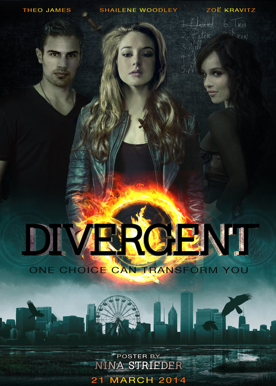
Another movie adaptation of a young adult book series based on a dystopian future? To the book’s credit, though, the movie plays it very closely. This movie (and book) follows the trend of movies in the last several years. They present young adults in bizarre or dangerous situations in which they have to make decisions, take risks, and go their own way. Non-conformity in a dystopian future appears to be the choice theme and hottest phenomenon these days. Just a thought…who’s to say that our future will be dystopian? Isn’t it just as likely that society may not be torn by wars of epic proportions or ravaged by zombies? I like to think society will blossom and improve. Oh well.
It’s ironic, if not a little predictable, that movies from books like these are nearly risk-aversive. With your producer breathing down your neck, why rock the boat and jeopardize a potentially wildly successful franchise if you don’t have to? “Divergent” is the latest movie in a long line of similar predecessors like “Hunger Games,” “Total Recall,” “Blade Runner,” yes and even “A Clockwork Orange.” Like in “Hunger Games” and “Harry Potter,” apparently only teenagers or young adults have the courage and honesty to stand up for what is right and challenge the system or order of the current world, which for all we know only consists of a future Chicago that resembles current Detroit.
Though its main appeal will most likely be to those who read the book and are young adults either chronologically or in spirit, “Divergent” does have something for the rest of those who will undoubtedly watch it; and that’s the chance to see the pair of performers who make that romantic music together. An early choice to play the lead, Shailene Woodley who plays Tris (hmm…where have we seen an underdog female protagonist in a dystopian future before?), is one of her generation’s most beautiful and promising young female actors. Picking her soul mate took a lot longer, but the studio’s selection of the devastatingly handsome Theo James to play Four has paid off. Both the actors have excellent chemistry on screen and serve as a glue for the film.
Although I have not read the book, from what I have been able to research, except for some minor nips and tucks, the screenplay follows the book fairly closely. The biggest change is the further development of the Machiavellian Erudite leader Jeanine Matthews, well played by Kate Winslet, into full-fledged villain status. However, her character’s position is unable to elicit empathy from the audience. And, an audience empathizing with the villain is important in a well-written story. Furthermore, the cause for the takeover by the Erudites (one of five main factions) is never fully explained.
Cinematography and editing wise, the film has a very instagram look; but, that is not entirely uncommon for these types of films. It was refreshing to venture out of the Dauntless caves every now and again to see other colors besides various hughes of black, brown, and red. Regarding the structure of the movie, most movies follow a classic three-act structure. But as the title suggests, this movie “diverges” from the classic structure of a cinematic narrative story. Act one lasts 3/4 of the film, and acts two and three are only 1/8 each. The slow pace in the beginning does pay off with the fast-moving pace in the last two acts.
All-in-all, this movie contains elements that are par for the course in this genre. But a well executed futuristic action-romance film. Definitely one that a family can enjoy together, and one from which young women and men can learn honestly, respect, and courage. A good way to spend 2.5 hours.
 R.L. Terry ReelView