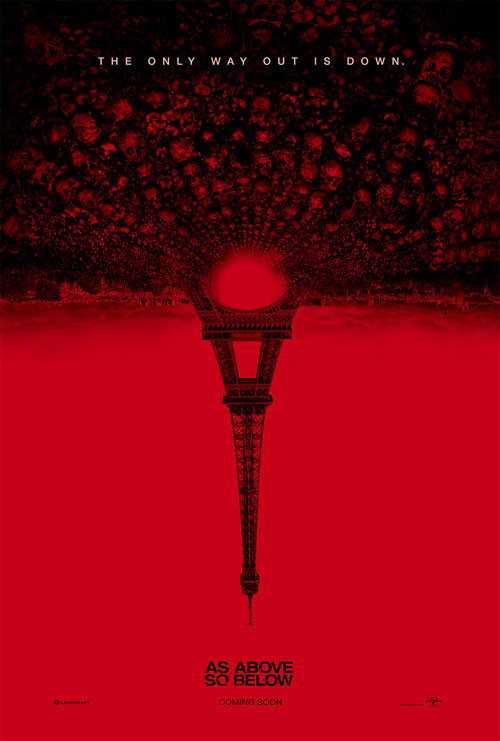
As Above, So Below

so-below-so-aboveIt’s that time of year again; get ready for the barrage of good and bad horror movies to usher in the Halloween season. The first out the gate is the paranormal found-footage thriller As Above, So Below. Take the plot and turning points from National TreasureThe Decent, and the 90s cult classic Blair Witch Project, throw them in a blender and what do you get? This movie. Borrowing heavily from the aforementioned movies, this film is one part treasure hunt and one part paranormal activity. With very little visceral horror and just a handful of jump-scares, this film creates the atmosphere of horror by successfully placing the audience into the same tight spaces, within the confines of the legendary Paris catacombs, as are the small band of explorers.

As Above, So Below is a found-footage film about a group of explorers, lead by the academic genius and treasure hunter Scarlett, who venture beneath the “City of Lights” into the dark world of the catacombs to seek the legendary Philosopher’s Stone (not to be confused with the one from Harry Potter). Following clues found in places as far away from Paris as Iran and on obscure medieval tombstones, the group uncovers a dark secret, only the labyrinth of twists and turns of the massive burial ground can hide.

Setting the claustrophobic feel of the movie at the very beginning, the audience is introduced to the treasure-hunter-professor Indiana Jones/Benjamin Gates-ish protagonist Scarlett (played by Perdita Weeks) by way of the iconic found-footage tool, the shaky cam. That cinematic move will prove to be key in setting the mood of the film for when we finally enter the catacombs. The chief cinematic element, this film relies upon, is creating an atmosphere of horror for the audience. In a manner of speaking, many times, it’s the unknown and close quarters that sets the fear barometer in the mind. Unlike some found-footage films, which are primarily taken from one or two cameras, this film utilizes handheld cameras and headlamp mounted cameras to get both first-person and third-person perspectives on the journey into the bowls of the earth. These shots allow the audience to feel trapped within the tight spaces and along with the characters on the screen, thus transferring the anxiety of the unknown and suffocating tight spaces into the mind.

Although the film sets the protagonist up to be an academic genius, in order to allow for her to draw the conclusions and interpret symbols on the fly in the catacombs, the quick speed and lack of cognitive strain she exhibits in the catacombs is unbelievable. The film would have played out better, had there been more demonstrable confusion and difficulty in solving the riddles and puzzles. Many scenes play out the same way they were in National Treasure, especially when Scarlett seeks the help of a colleague who feels she is a lunatic for seeking the legendary Philosopher’s Stone. Likewise, many situations and even some of the dialog is reminiscent of The Decent. Much like in The Blair Witch Project, the paranormal apparitions and figures are seldom seen and never fully explained–this aids in the unknown horror of the film. Between the physical spacial horror and handful of jump-scares, this film will have you on the edge of your seat in anticipation of what is to come.

This is the type of horror film that will have you and your friends talking about it the next day. Many of the connections between the history of the catacombs and respective pasts of the characters and the present horror they face, will not be realized until after the film comes to a close. But, this is what gives this particular horror film a win for the genre. For those who hope for visceral horror in a film, this may not be for you; however, if you enjoy paranormal films grounded in a little history and mystery, then you will most likely enjoy this 90-minute journey into the dark underworld of Paris where it’s sometimes the opposite of what is logical that will save you.
Magic in the Moonlight

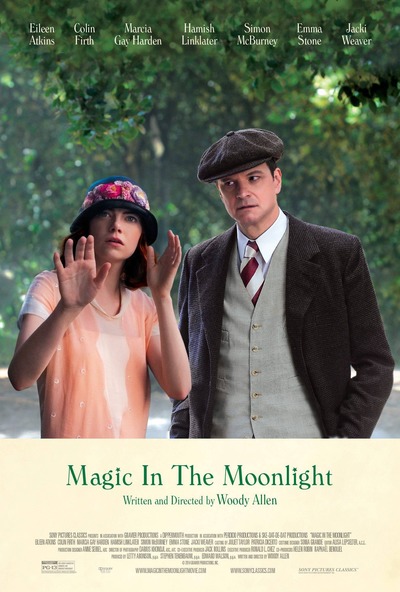
Magic MoonlightMagicians, the roaring 20s, Saint-Saens’ orchestral masterpiece, and more can be found in this endearing tale of mystery and unconventional romance. Written and directed by the timeless Woody Allen, Magic in the Moonlight is a pleasure to watch–absolutely perfect from every perspective. Emma Stone and Colin Firth are captivating in this memorable tale aptly released by Sony Pictures Classics. Indeed, this is a new classic that all who watch will definitely enjoy. No glitzy CGI, breathtakingly elaborate cinematography, or smoke and mirrors in this magician’s tale. It’s truly a throwback to the very essence of what an excellent film should be. No political, social, or psychological message here; just pure visual and performing art–Ars Gratia Artis.

Magic in the Moonlight is about a famous magician (Firth)–think the David Copperfield of the 1920s–who is brought to the South of France to debunk and unmask a self-proclaimed medium named Sophie (Stone). Setting out to reveal her, as he exposed countless charlatans prior to her arrival, he discovers that her claim of clairvoyance may actually be authentic. Watch as the world’s foremost magician uses logic, wit, reason, and science to see through the act, he believes she is putting on. Fortunately for Sophie, her gift has caught the eyes of the South of France’s elite, and the son of great fortune falls in love with her. This movie is full of twists and turns, romance and intrigue–a perfect combination for such a wonderful film.

Woody Allen is a brilliant writer/director who can take a simple concept and build a beautiful movie around it. He movies are full of people who face real problems and shows how they work through them. Sometimes they solve their problems, as is the case with Owen Wilson’s character in Midnight in Paris; but other times they are lost in the confusion of their own minds, like the Academy Award winning performance given by Cate Blanchette in last year’s Blue Jasmine. Emma Stone and Colin Firth play off each other so precisely and strategically. Firth’s sarcasm and cynicism is matched by Stone’s charm and optimism. Just goes to show that a wonderful movie does not have to be overly directed or produced in order to showcase a story. Woody Allen never ceases to amaze me at his grasp and understanding of the importance of “story.” Without story, without conflict, there can be no movie. This movie truly relies on the story to carry the film.

If you are a fan of Saint-Saens’ Carnival of the Animals, then you will love the opening scene that takes place at a magic show at a theatre in Berlin. Such a beautiful masterpiece. Although only the first few measures are ever heard, in the movie, it really adds a touch of class to the film, giving it a very classically produced feel. From classic orchestral movements to the swinging music of the 1920s, Magic in the Moonlight has a memorable score that definitely creates a perfect atmosphere for the telling of this well-crafted story.

Lastly, it isn’t often that a story written for screen can translate seamlessly to the stage. But, this film would make an excellent stage production as well. The movie is dialog-driven and carried by two central characters with a handful of chief supporting cast. Seeing this film brought to stage could allow for a unique experience that cannot be achieved on the screen. Although, it was a wonderful cinema experience, I could see how bringing it to stage could permit the characters to come to life in a different way that allows the audience to immerse themselves into the story.

If you have some time, while it is still in theatres, check it out. Whether you are a fan of Woody Allen’s unique style or not, it is a great movie in which all can find enjoyment.

The Giver

GiverRemember reading the short novel in school? Now, you can experience the movie. Yes, I am really behind with this one…I was on a short vacation for several days. Although you may have seen it this past weekend, if you have yet to make time to see it, it’s definitely one that you and your friends or date can enjoy. Unfortunately, this movie presents, at best, a satisfactory cinema experience. Having not read the novel, I cannot compare and contrast the screenplay to the originating literature. On the positive side, this movie really has all the elements of a well produced and directed film. However, the movie is quite rushed and ends with the audience wondering “was that it…it’s over?”

Upon watching the first few minutes of the movie, I was quick to draw the conclusion that this was another Hunger Games or Divergent; but, a colleague of mine was quick to point out that the children’s novel The Giver, written by Lois Lowry, was released in 1993. So, if anything, the novel The Giver served as the source of inspiration for The Hunger Games and Divergent. Looking at the larger picture, The Giver appears to be the product of some junior executive at Walden Media and the Weinstein Company deciding that these types of movies are what people want to see, and decided to produce yet another movie featuring attractive young people challenging their respective societal norms to better society by promoting individuality over “sameness.” Although it’s a plot that is relatively new, it is getting old quickly. But, it’s a sure fire way to get tweens and teens to get their parents to spend money on movies and books.

The setting is a utopian society where in the year 2048, after a big war, “the community” had decided to get rid of colors, therefore different races, and feelings, such as love and anger, because they felt that they only caused conflict. In their community, everything is about sameness, thus there is no money or social status, everyone owns the same things, and everyone lives in a same sized house. There are ceremonies each year to celebrate the age of a child, culminating at age 18 with the “Ceremony of Growth”, where children are assigned careers. Jonas, the main character, thinking he has been skipped over at the ceremony by the chief elder (played by Meryl Streep), is assigned the job “receiver of memory” because not one in the society, except for select elders, have any memory of life before [what is referred to as] “project sameness.” Yet as Jonas begins to spend time with The Giver (Jeff Bridges), who is the sole keeper of all the community’s memories, Jonas quickly begins to discover the dark and deadly truths of his community’s secret past. With this newfound power of knowledge, he realizes that the stakes are higher than imagined – a matter of life and death for himself and those he loves most. At extreme odds, Jonas knows that he must escape their world to protect them all – a challenge that no one has ever succeeded at before.

The biggest problem with the movie is the structure and pacing. It’s always difficult to watch a movie that has all the right elements and dynamics, but fails to fully develop them due to cramming the movie into a 90min run time. A well-written movie (or screenplay) is divided up into three distinct acts. The Giver feels like it only has two acts. And, the first act takes up most of the movie, leaving the climax and resolution to makeup the last 15-20mins. Jeff Bridges delivers a commanding and convincing performance as the Giver but Meryl Streep delivers just a satisfactory performance for her character, the Chief Elder. The characters, plot, and direction really build up the movie and generate anxiety and anticipation for what is to come next. But, then the movie is over. And the audience is left feeling like they need more. Think of it this way. Remember being a virgin, and going to have sex for the first time? Remember how the foreplay and anticipation were amazing and thrilling, but then you popped too quickly and your partner was left with “oh, is that it…is it over?” That’s pretty much this movie, in a nut shell.

All in all, it is a very satisfactory cinema experience. It’s not terrible, but not very memorable either. Perhaps it will inspire a new generation of young people to read the 1993 children’s novel. Some of the cinematography is beautiful and really complements the big screen. So, you will not feel like you wasted your money on the $8-10 ticket to watch this movie in theatres.

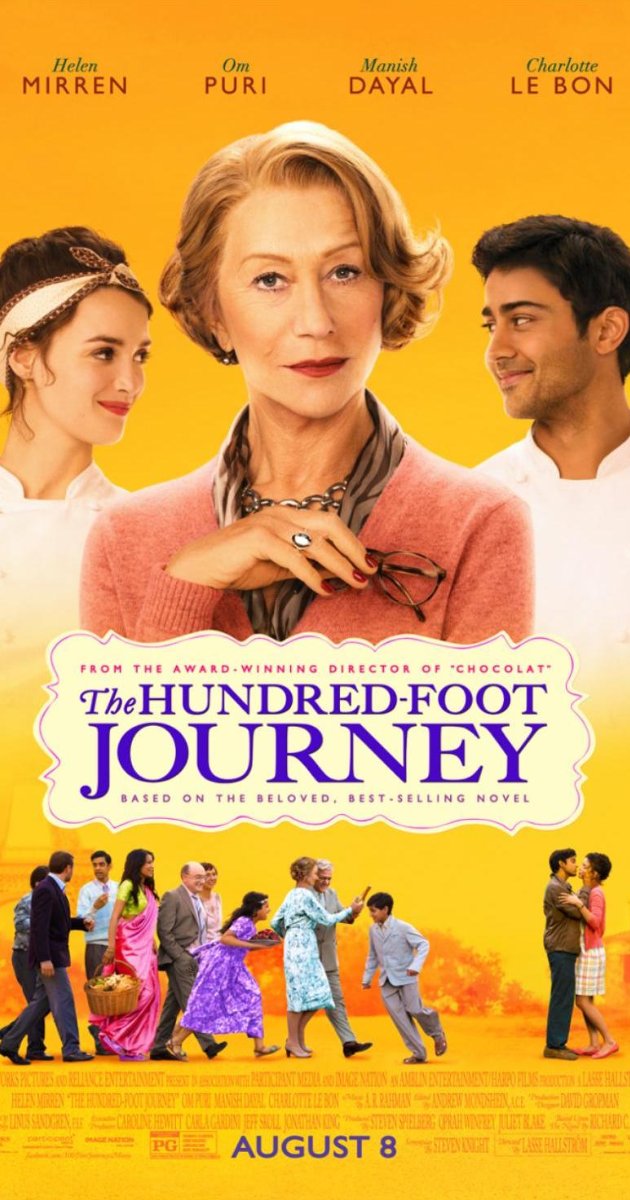
The Hundred-Foot Journey

100ft JourneyBeautifully satisfying! It isn’t often that a movie can be summed up with simple adjectives; but, this movie has what it takes to mesmerize audiences with the unique blend of beauty and charm. From picturesque landscapes that cast a spell on the mind to relaxing meadow brooks that leap right off the canvas of a Thomas Kinkaid painting, the story of two competitive restaurants in a quaint provincial French village unfolds before your eyes. Add exquisite talent and a sweeping score, and you have an instant classic tale of romance and cuisine. From the Oprah praised novel The Hundred-Foot Journey written by Richard C. Morais, comes a movie with an impeccable screenplay and a pedigree of talent on and off the screen. Some of our fondest memories involve the sights and aromas of food for the holidays or other special occasions; and, this movie showcases just how important food is, not merely as a way to sustain life, but as a way to explore and live life to the fullest.

The motion picture adaptation of the novel by the same name is about a refugee Indian family who flees to Europe after their restaurant is destroyed by the opposition party following an election that placed the patriarch of the [Kadam] family in a position of power in the village. After the brakes on their jalopy of a car fail outside of a French village, the family begins to build a new life–and building a new life means opening an Indian restaurant. It’s nearly instant that the Kadam family clashes with Madame Mallory (Hellen Mirren), the proprietress of a celebrated French restaurant and finest one for miles, after they open their own nearby eatery. The rivalry continues until undeniable chemistry causes the Madame to take gifted young chef Hassan under her wing as East meets West. Very much in the vein of The Best Exotic Marigold Hotel.

One of the most intriguing aspects to this foodie fairytale is the talent behind the beautifully written screenplay. Veteran screenwriter Steven Knight, who’s best known for his gritty London underworld thrillers, recently came off an unusually adventurous directing debut with Locke. It’s worth noting that his scripts like his Eastern Promises and Dirty Pretty Things usually cater to the edgier content and were directly concerned with the hostilities bred in and around specific immigrant communities. Still, this screenplay is not without the hostility that we have come to associate with Knight. He uses his literary prowess to contrast the heat and intensity of Indian cooking with the elegance and refinement of French haute cuisine, then balances the two with a feel-good lesson in ethnic harmony. So many of the characters experience some type of development. The character development, in this movie, is extremely dynamic and heartwarming. Undoubtedly, one of the characters will find a place into your heart as you watch this film that is essentially a cross between Slumdog Millionaire and Ratatouille.

Hellen Mirren never fails to cast her enchanting spell on audiences no matter what her role. Though she’s encumbered somewhat by her French accent, Mirren is superb at both projecting an air of hauteur and expressing the vulnerability beneath it, and she brings out a similar mix of pride and feeling. Her counterpart, best known as Papa,  played by Om Puri, is such a great patriarchal figure because his stubbornness and desire for success never overshadow his love for his family. Furthermore, he plays such a brilliant sparing partner for Mirren’s Madame Malory. They are able to play the “tit for tat” element early on in the movie extremely well. Both characters find a perfect blend of humor and tenacity. Very often, there are subtle references to plot points in Disney’s Ratatouille, and it makes for excellent kitchen comedy. Food is more than a way for the body to generate energy; it’s a window to the soul.

Produced by Steven Spielberg, Oprah Winfrey, and Juliet Blake, this movie is a brilliant combination of a quirky romantic comedy and soon-to-be art house favorite. In addition to the amazing direction provided by Lasse Hallstrom, the cinematography by Linus Sandgren is captivating in every frame; and in a stunning fashion, advances the story in such a way that the visuals make love to the eyes. And if you are in the mode for an intense passionate sweeping score, then you will love the music by A.R. Rahman. So, what are you waiting for? Grab a date and head for an evening at the cinema!

Guardians of the Galaxy

GuardiansSuch a pleasant surprise to round out the summer blockbuster season. Guardians of the Galaxy is quite possibly the best Marvel superhero movie ever! Whether you’re a fan of comic book genre action films or someone who loves character actors with witty and edgy dialog, you will most likely thoroughly enjoy this film. Everything from the completely un-original soundtrack to the casting (with one exception) to the well executed dialog, made this a fun movie to watch and laugh along with. I am someone who typically doesn’t jump at this genre of film; but thankfully, I was invited with some friends to see it. And, I am very happy I decided to go. Probably the best part was the audience all joining the soundtrack and singing “Ain’t No Mountain High Enough” (the Michael McDonald/Diana Ross version) at the close of the film. If you are a child of the 70s/80s or just love the pop music from that era, you will likely find yourself signing along with the movie.

Guardians of the Galaxy plot summary: After stealing a mysterious orb, American pilot/outlaw hero Peter Quill is hunted down and thrown into an inter-galactic prison. In order to secure his freedom, Quill reluctantly joins forces with alien bandits Drax, Gamora, Rocket and Groot to form an alliance of misfits known as the Guardians of the Galaxy, and with the all-powerful villain Ronan hunting the orb, the fate of the universe is in their hands.

Who would’ve known that former schlub Chris Pratt (as he was introduced to mass audiences on Parks and Recreation), who plays Starlord, would turn out to be a sexy buff Han Solo-esque character in a movie that is both a figurative Firefly pitched at 15-16yos with many nods and easter eggs pointed at Star Wars. One of the funniest and slightly irreverent lines in the whole movie was when the comment is made about Starlord’s ship being filthy; and he replies with a line about how if one used a backlight, his ship would look like a Jackson Pollock painting. Fortunately, many of the lines filled with adult innuendo will go right over the kid’s heads that are most likely watching the movie. But, it gives something for the parents, college students, and young professionals to laugh alone with.

Each one of the characters is very unique and offers a different brand of entertainment. There is the badass feminist Gamora (played by Zoe Seldana), the only obvious casting mistake in the movie; the cynical Rocket (voiced by Bradley Cooper); the heartwarming Groot (played by Vin Diesel); and the tough guy with a heart of gold Drax (played by WWE’s Dave Bauista). Combine the colorful cast of characters with the brilliant direction and co-writing of James Gunn and you get a sure-fire hit for the summer. It’s not often a comic book movie can appeal to a diverse audience in terms of age; but, this movie accomplishes just that. Amidst the relatively fresh Hollywood talent in the movie, you have some Hollywood royalty making bit appearances such as the brilliant performer and well-accomplished Glenn Close playing the mayor/governor of the empire of Xandar.

One of the best parts about the movie, isn’t even the visual parts that make up a work of cinema, in the true sense of the definition–the soundtrack. From the moment we see adult Starlord to the moment the audience (SITS THROUGH THE CREDITS) gets up to leave, there are pop songs from the 70s/80s that will nearly make you get up and dance while the all-too-familiar and nostalgic lyrics and notes make love to your ears. Although I am someone who prefers an original soundtrack (with popular or poignant songs making appearances now and again), this soundtrack fits this movie perfectly. I cannot imagine this movie without the notable songs being played off an original Sony Walkman with cassette tape.

So, if you want an exciting movie that will also bring laughter and tears to your face, check out Guardians of the Galaxy. Gather your friends together and make an evening out of it. This is definitely the type of movie that is best enjoyed with friends who will laugh along with you and enjoy the vast array of characters and well-executed dialog as the summer, for many, comes to a close soon.