Annabelle

AnnabelleIf Chucky was worried he would lose his place amongst the creepiest dolls in cinema history to Annabelle, he needn’t worry any longer. The much anticipated followup/prequel to the fact-based horror hit The Conjuring, directed by James Wan, featuring the possessed doll who’s cameo sparked interest in the original film, does not live up to expectations. It certainly has its moments of unheimlich (uncanny) as laid out by Sigmund Freud in his study on horror, causing some anxiety and terror; but, the narrative just doesn’t hold up very well and was not handled as well as it could have been. However, it is a good movie to watch with friends during the month of October, or if you are looking for a decent scare during which you can hold on to your date’s arms or vice versa.

Annabelle is about the story of the possessed doll that famed and ordained supernatural and paranormal experts Ed and Loraine Warren (most famously known for their investigation into the Ammityville case), still to this day, have locked away in a glass cabinet that is blessed by a priest twice a month. Prior to coming into possession of the doll, Annabelle once belonged to a young couple as part of an extensive doll collection. Following a brutal murder next door and an attack upon themselves by the neighbors estranged and mentally disturbed daughter, John and pregnant Mia discover that their attackers were part of a Satanic cult involving blood sacrifice. Unfortunately, the attackers conjured up more than a plan of attack. A malevolent and unprecedented evil entity now occupies the doll, in the pure white dress, as a conduit from the spiritual world into ours. John and Mia must uncover why the doll is hell-bent on their utter destruction and drive the evil spirit from it before it harms their family.

The failed haphazard screenplay, written by Gary Dauberman, took the low-rent approach to horror and just had cheap scare after cheap scare throughout the story. In stark contrast to The Conjuring, there is little to no fact-based content in the story at all, save the archival footage from the Warren’s interview with the young ladies who were last in possession of the Satanic doll. Unlike Chucky, Annabelle is never seen directly orchestrating any of the horrific incidents during the movie–not even so much as moving her eyes or head. With the exception of the doll occasionally being found out of place, the doll is fairly stationary. Both the direction and writing are week and is little more than a Chiller or SyFy channel original movie.

The film is very generic in story and structure, and will likely be a faint memory by the time you get back home. It is obvious that the film would have faired by much better had Wan taken the reigns instead of turning it over to another less capable director, who directed films like Mortal Kombat: Annihilation. Equally unmemorable are the two leads. Their respective performances were so bland that it will have you looking for the salt to add flavor, or look for the cue cards they are obviously reading. The film will most like rake in the cash and create a nice profit for Warner Bros and New Line due to the low budget (with respect to comparable theatrical films). If you can only see one movie this weekend, definitely select Gone Girl over Annabelle.

The Maze Runner

Maze RunnerGet ready for yet another movie featuring attractive young people (this time, all guys except for one girl) trapped in a daunting situation that they cannot figure out. Once again, we are faced with a young adult fantasy thriller that sits somewhere between The Hunger Games and Divergent, but throws in a little Lord of the Flies and Peter Pan for some literary credit for the older or more educated audiences. Seemingly a rip off of the aforementioned recent theatrical films, The Maze Runner is another in the lineup of movies based on best-sellers, wherein 18-21 year-olds are the only ones who can save an entire civilization from utter destruction. Director Wes Ball and his young cast work very hard to overcome any apprehension or feelings of boredom the audience many have for this quickly proliferated genre of film.

The Maze Runner is about Thomas, played by Dylan O’Brien, a young man who wakes up to find himself in a strange land populated only by guys. Alby (Aml Ameen) is the leader, who keeps order with steady Newt (Thomas Brodie-Sangster) and hot-headed Gally (Will Poulter). The group has only one set of instructions–cooperate and survive. Having a much more curious mind than his counterparts, Thomas is determined to find out how to escape the maze and find out how and why they are trapped. Unfortunately, Thomas is met with constant opposition, mostly from Gally, because he is upsetting the order under which the guys have survived. Quickly proving himself to be courageous and loyal, Thomas must use his curiosity, speed, and ingenuity to escape the dark and sinister ever-changing maze to answer the foreboding question of what lies beyond.

The movie bears a striking resemblance to the plot of Lord of the Flies in that there is no “adult,” although the lead boys are obviously of adult age, supervision. And, these young people must develop their own set of laws and mores in order to continue to survive within the lush glade, that sits in the middle of a maze with walls of incredible height. Nearly an all-male cast, the guys encounter one girl who is sent to them with their last shipment of monthly supplies, who is so underused that she comes across as merely a token gesture to the females who are watching this movie designed for a mostly male audience. Largely unknown performers, the cast is able to pull off this hybrid teen/adult fantasy thriller by making his stock role stand out.

Some of the refreshing aspects to this movie, as compared to its other dystopia film brethren, is the missing element of a love triangle or town elders who barf up needless loads of mythology and narrative exposition thus turning this visual medium into a play. Not that plays and musicals are bad, but they are dialog driven whereas a movie should be visually driven. And, The Maze Runner has visual storytelling down in spades. Many times, it felt like watching a graphic novel on screen. After so many films have essentially lowered the expectations of these young adult movies based on best-sellers, this film tries to make up for where the others fail. This is especially clear when the movie pushes its PG-13 rating by showing the young people dying horrific deaths as a result of madness or the macabre creatures of the labyrinth.

Even though the acting is surprisingly good, for this genre, and it drops the cliche love story subplot, the movie suffers from a horrendous score and terrible sound design. In fact, this “film” looks and sounds more like a SyFy Channel original movie (with better acting, of course) than it does a cinematic release. However, if you can watch the movie in DBox seats, it definitely enhances the experience. One can only hope the sequels to the film will boost production quality (and no, I am not talking about CGI) and create a more cinematic feel to the movie. Moving forward, hopefully the plot will be bolstered by more narrative substance that could achieve the quality of film that this new franchise is capable of. On the plus side, there is a great twist in the end that elicited definite “whoa” response from the audience. Although there were points in the film that were way too cliche and predictable, I am looking forward to see how the subsequent sequels are handled.

If you are looking for something new here, you will not likely find it. However, sometimes it’s perfectly acceptable for a movie to be merely entertaining rather than possessing the ability to aMAZE the audience.

No Good Deed

No Good DeedIf you are looking for a good group movie experience, filled with twists, turns, and surprises, then check out No Good Deed. Every once in a while, there comes a good suspense movie that does well in a date or group setting. With it’s quick pacing and ability to hook the audience within the first five minutes, this film will keep you on the edge of your seat from start to finish. A good horror film (yes, this falls into that genre), possess the ability to consistently keep the audience in a state of anticipation for what is to come or in a state of disorder. The classic format of a horror movie is order, disorder, and order again. In recent times, it is not surprising when a horror movie follows order then disorder. And, in less than an hour and a half, No Good Deed its all the pacing points for proper structure.

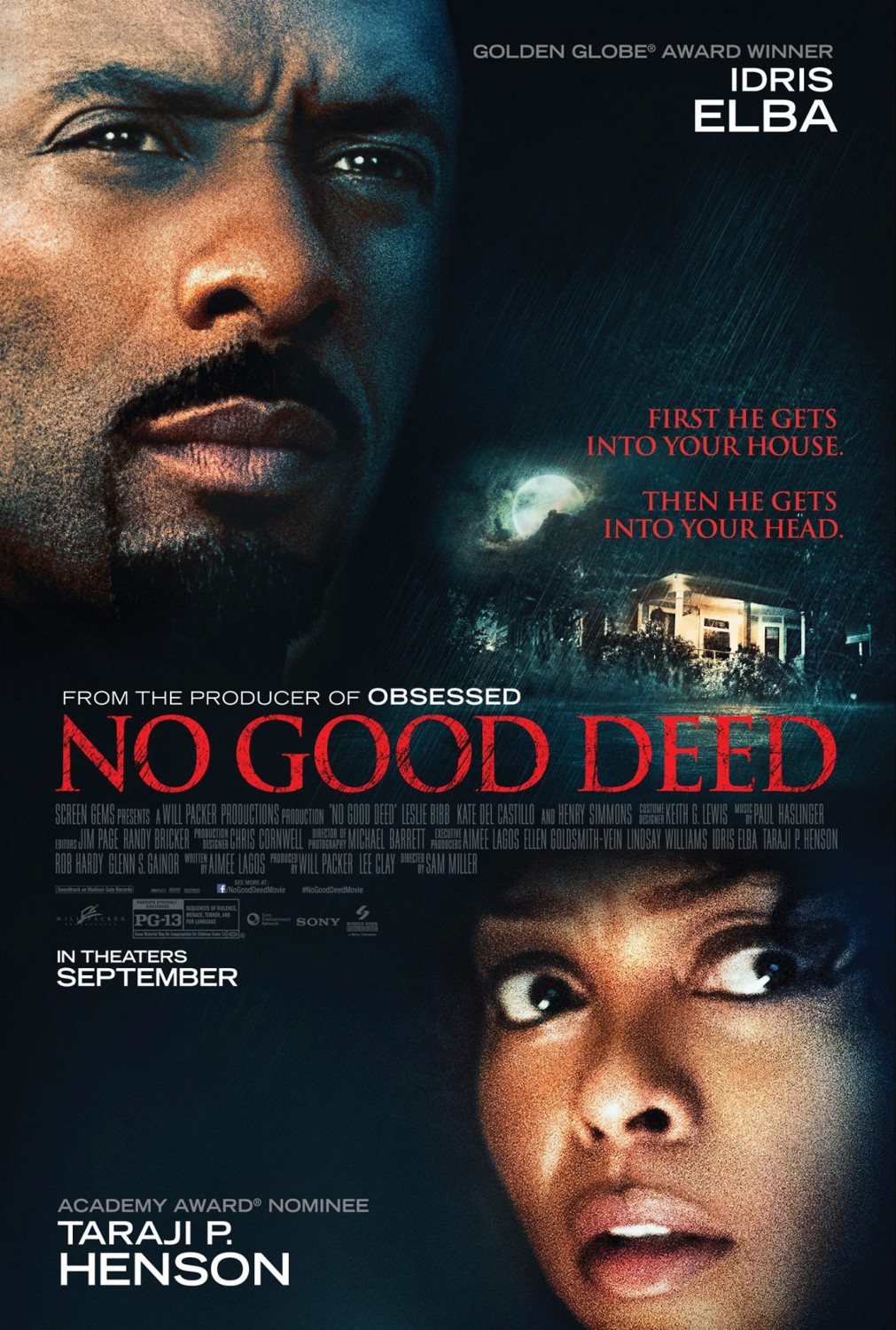
No Good Deed is a film about an escaped convict named Collin, played by Idris Elba, who wrecks his truck, during a storm, and asks to use the phone at the house belonging to Terri, played by Taraji P. Henson. Generous, but unsuspecting Terri invites him into her home and through a series of events, he terrorizes Terri and her two children. Seemingly cut off from the world, and having to protect her children first, Terri must find a way to escape from the clutches of the malevolent presence of and psychologically unstable Collin.

This is a good example of a film that truly belongs on television–specifically Lifetime or Lifetime Movie Network. It’s not that it’s a bad movie–quite the opposite–it’s an enjoyable movie-going experience; but, the quick pace, lack of exposition, and cliche turning points lends this movie to be more effective on a network versus a movie theatre. In other words, No Good Deed lacks the cinematic feel of a film but possesses an excellent television movie feel. It’s almost as though the producers originally had an idea for a TV movie that they decided, by throwing some notable actors in it, that it could be a theatrical release instead of on CBS (owned by Sony) or Lifetime.

**SPOILER ALERT** In order to discuss further some of the negative critiques of the film, it is necessary to talk about elements that could spoil the film for those who intend to watch it. If need be, you can skip to the last paragraph.

Although, there are many troubling issues with the writing, the one issue that seems to be the most bizarre and overlooked by the writers is the fact that the affair Jeffrey (Terri’s husband) is having with the, now, deceased Alexis (former fiancé of Collin) was supposed to be happening at a hotel. Ordinarily, this would be commonplace for an affair; but, by way of the fateful note that Jeffrey left for Alexis on her pillow, we know that they were clearly sleeping together at her house. Why now the need for a hotel??? Another error is the fact that Collin heads to Jeffrey’s house to seek revenge on him. But how the hell was he supposed to know that Jeffrey was or wasn’t going to be home? Seems to me, that some of the events and turning points were nearly forced to keep the quick pacing to tell the story in under an hour and a half.

All-in-all, No Good Deed makes for an enjoyable movie experience with your friends. If you have one of those free passes to your local theatre, this would be a perfect movie for the free pass because if has the TV flair to the plot and production value.

As Above, So Below

so-below-so-aboveIt’s that time of year again; get ready for the barrage of good and bad horror movies to usher in the Halloween season. The first out the gate is the paranormal found-footage thriller As Above, So Below. Take the plot and turning points from National TreasureThe Decent, and the 90s cult classic Blair Witch Project, throw them in a blender and what do you get? This movie. Borrowing heavily from the aforementioned movies, this film is one part treasure hunt and one part paranormal activity. With very little visceral horror and just a handful of jump-scares, this film creates the atmosphere of horror by successfully placing the audience into the same tight spaces, within the confines of the legendary Paris catacombs, as are the small band of explorers.

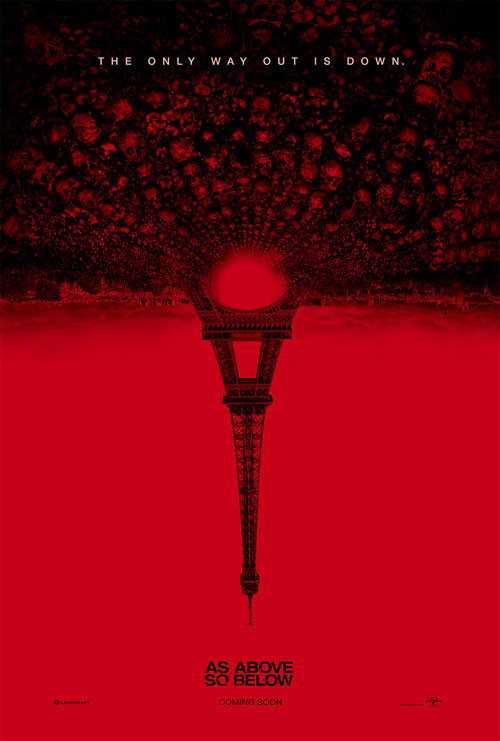
As Above, So Below is a found-footage film about a group of explorers, lead by the academic genius and treasure hunter Scarlett, who venture beneath the “City of Lights” into the dark world of the catacombs to seek the legendary Philosopher’s Stone (not to be confused with the one from Harry Potter). Following clues found in places as far away from Paris as Iran and on obscure medieval tombstones, the group uncovers a dark secret, only the labyrinth of twists and turns of the massive burial ground can hide.

Setting the claustrophobic feel of the movie at the very beginning, the audience is introduced to the treasure-hunter-professor Indiana Jones/Benjamin Gates-ish protagonist Scarlett (played by Perdita Weeks) by way of the iconic found-footage tool, the shaky cam. That cinematic move will prove to be key in setting the mood of the film for when we finally enter the catacombs. The chief cinematic element, this film relies upon, is creating an atmosphere of horror for the audience. In a manner of speaking, many times, it’s the unknown and close quarters that sets the fear barometer in the mind. Unlike some found-footage films, which are primarily taken from one or two cameras, this film utilizes handheld cameras and headlamp mounted cameras to get both first-person and third-person perspectives on the journey into the bowls of the earth. These shots allow the audience to feel trapped within the tight spaces and along with the characters on the screen, thus transferring the anxiety of the unknown and suffocating tight spaces into the mind.

Although the film sets the protagonist up to be an academic genius, in order to allow for her to draw the conclusions and interpret symbols on the fly in the catacombs, the quick speed and lack of cognitive strain she exhibits in the catacombs is unbelievable. The film would have played out better, had there been more demonstrable confusion and difficulty in solving the riddles and puzzles. Many scenes play out the same way they were in National Treasure, especially when Scarlett seeks the help of a colleague who feels she is a lunatic for seeking the legendary Philosopher’s Stone. Likewise, many situations and even some of the dialog is reminiscent of The Decent. Much like in The Blair Witch Project, the paranormal apparitions and figures are seldom seen and never fully explained–this aids in the unknown horror of the film. Between the physical spacial horror and handful of jump-scares, this film will have you on the edge of your seat in anticipation of what is to come.

This is the type of horror film that will have you and your friends talking about it the next day. Many of the connections between the history of the catacombs and respective pasts of the characters and the present horror they face, will not be realized until after the film comes to a close. But, this is what gives this particular horror film a win for the genre. For those who hope for visceral horror in a film, this may not be for you; however, if you enjoy paranormal films grounded in a little history and mystery, then you will most likely enjoy this 90-minute journey into the dark underworld of Paris where it’s sometimes the opposite of what is logical that will save you.

Magic in the Moonlight

Magic MoonlightMagicians, the roaring 20s, Saint-Saens’ orchestral masterpiece, and more can be found in this endearing tale of mystery and unconventional romance. Written and directed by the timeless Woody Allen, Magic in the Moonlight is a pleasure to watch–absolutely perfect from every perspective. Emma Stone and Colin Firth are captivating in this memorable tale aptly released by Sony Pictures Classics. Indeed, this is a new classic that all who watch will definitely enjoy. No glitzy CGI, breathtakingly elaborate cinematography, or smoke and mirrors in this magician’s tale. It’s truly a throwback to the very essence of what an excellent film should be. No political, social, or psychological message here; just pure visual and performing art–Ars Gratia Artis.

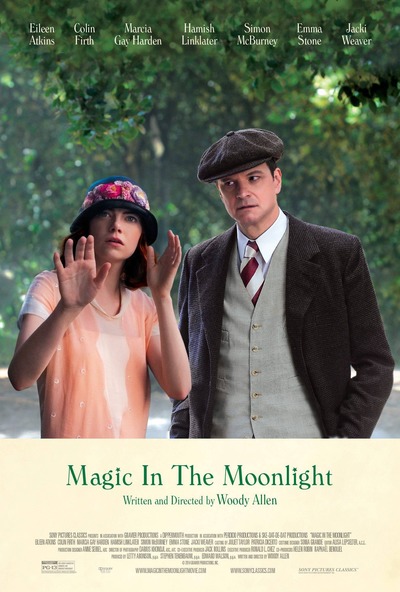
Magic in the Moonlight is about a famous magician (Firth)–think the David Copperfield of the 1920s–who is brought to the South of France to debunk and unmask a self-proclaimed medium named Sophie (Stone). Setting out to reveal her, as he exposed countless charlatans prior to her arrival, he discovers that her claim of clairvoyance may actually be authentic. Watch as the world’s foremost magician uses logic, wit, reason, and science to see through the act, he believes she is putting on. Fortunately for Sophie, her gift has caught the eyes of the South of France’s elite, and the son of great fortune falls in love with her. This movie is full of twists and turns, romance and intrigue–a perfect combination for such a wonderful film.

Woody Allen is a brilliant writer/director who can take a simple concept and build a beautiful movie around it. He movies are full of people who face real problems and shows how they work through them. Sometimes they solve their problems, as is the case with Owen Wilson’s character in Midnight in Paris; but other times they are lost in the confusion of their own minds, like the Academy Award winning performance given by Cate Blanchette in last year’s Blue Jasmine. Emma Stone and Colin Firth play off each other so precisely and strategically. Firth’s sarcasm and cynicism is matched by Stone’s charm and optimism. Just goes to show that a wonderful movie does not have to be overly directed or produced in order to showcase a story. Woody Allen never ceases to amaze me at his grasp and understanding of the importance of “story.” Without story, without conflict, there can be no movie. This movie truly relies on the story to carry the film.

If you are a fan of Saint-Saens’ Carnival of the Animals, then you will love the opening scene that takes place at a magic show at a theatre in Berlin. Such a beautiful masterpiece. Although only the first few measures are ever heard, in the movie, it really adds a touch of class to the film, giving it a very classically produced feel. From classic orchestral movements to the swinging music of the 1920s, Magic in the Moonlight has a memorable score that definitely creates a perfect atmosphere for the telling of this well-crafted story.

Lastly, it isn’t often that a story written for screen can translate seamlessly to the stage. But, this film would make an excellent stage production as well. The movie is dialog-driven and carried by two central characters with a handful of chief supporting cast. Seeing this film brought to stage could allow for a unique experience that cannot be achieved on the screen. Although, it was a wonderful cinema experience, I could see how bringing it to stage could permit the characters to come to life in a different way that allows the audience to immerse themselves into the story.

If you have some time, while it is still in theatres, check it out. Whether you are a fan of Woody Allen’s unique style or not, it is a great movie in which all can find enjoyment.